
Guest posting is a highly effective digital marketing strategy that offers numerous other benefits besides the obvious one: legit, solid link building. It increases brand awareness, attracts more targeted traffic, strengthens industry credibility and valuable relationships. Also, guest posting provides a competitive advantage: it allows using the power of content published on other websites.
This article covers everything you need to know, from suitable tools and opportunities and crafting compelling content to maximizing guest posting’s SEO impact and will be useful no matter whether you’re a beginner or a seasoned pro.
Why Guest Posting Works in 2026
Guest posting is the practice of publishing original, editorial-style content on relevant third-party websites in exchange for visibility, authority, and usually a contextual backlink. At its best, it’s not “link placement” but earned citation since your content contributes to the host site, and the link supports the narrative rather than forcing it.
Unlike sponsored content (paid placement), PR mentions (uncontrolled coverage), or UGC links (forums, comments), guest posts give you editorial context and message control.
More than 43% of marketers use guest posts for SEO at least occasionally.
Source: Semrush.
So why does it still work in 2026?
Because SEO has shifted away from raw link volume toward credibility signals. Search engines now evaluate where links come from, how consistently a site is referenced, and whether those mentions align with topical authority. Guest posts (when done right) check all of those boxes.
Of course, SEO guest post strategies keep changing. Here’s what’s different in 2026:
- Generic SEO guest posts don’t move rankings as much anymore
- Thin sites with inflated metrics are ignored
- Isolated placements without link history look artificial
What does work is publishing on real sites with audiences, stable link profiles, and editorial standards and doing it consistently. This way, guest posting in SEO allows you to earn your place in the topic conversation.
The Difference Between Guest Posting and Regular Blogging
But what are the differences between the two most distinct avenues for content dissemination: guest posting and regular blogging? Though they both involve the creation and publication of content into the online sphere, a closer examination reveals that these practices possess nuances that set them apart, each serving as a valuable tool for communication and engagement. We’ll explain a few of the differences below, allowing you to understand the effectiveness of guest posting more thoroughly.
Platform Ownership:
Guest Posting: The main purpose of guest posting lies in the ability to contribute content to a third-party website. In this scenario, an expert can step into the role of a guest, sharing your insights on a platform that belongs to another.
Regular Blogging: Alternatively, regular blogging involves the publication of articles on your own website or blog. In this case, you have full ownership, controlling the process of content creation, presentation, and its promotion.
Purpose & Objectives:
Guest Posting: This method predominantly serves the purpose of increasing outreach. Guest bloggers seek to tap into wider audiences, garner backlinks, and establish themselves as authoritative figures within their chosen area of expertise or industry.
Regular Blogging: While some objectives may overlap, regular blogging encompasses a twofold focus. It caters not only to existing viewership, but also emphasizes maintaining site SEO, nurturing the current audience, and providing a steady stream of innovative content.
Editorial Control:
Guest Posting: When engaging in guest posting, authors often encounter editorial processes on the host website. This might involve revisions and adherence to specific guidelines set by the hosting platform.
Regular Blogging: In the realm of regular blogging, you retain complete control over your content. This encompasses decisions regarding content style, formatting, and publication schedule.
Audience Interaction:
Guest Posting: Interaction through guest posting is primarily directed towards a new or unfamiliar audience. This offers a unique opportunity to leave a lasting impression and potentially amass new followers or customers, whilst also establishing yourself as an expert within this niche.
Regular Blogging: With regular blogging, on the other hand, content creation entails interaction with an audience that is already familiar with your content. This interaction occurs within a context where a relationship with readers has already been established and intends to be continued.
Longevity & Maintenance:
Guest Posting: Once a guest post goes live, updates can be limited and are usually based on the policies of the host site. Any future modifications are often subject to the host’s editorial decisions and guidelines, as agreed upon.
Regular Blogging: Regular blog posts provide you with the flexibility to frequently update, optimize, or even remove content as needed. This control ensures that your digital narrative remains both relevant and accurate.
In essence, while both guest posting and regular blogging have considerable power as separate content marketing strategies, they serve distinct purposes and require a nuanced approach. By recognizing the differences between these two methods, writers and marketers can be empowered to maximize the potential impact of their content. By tailoring their efforts to align with the specific strengths of each practice, creators can align to their digital footprint, fostering connections with audiences both old and new. As the digital landscape continues to evolve, the interaction between guest posting and regular blogging remains an essential cornerstone of effective content distribution and audience engagement.
Benefits of Guest Posting for SEO
Guest posting offers much more than just backlinks. It’s a comprehensive strategy that increases your online visibility and improves your search engine optimization.
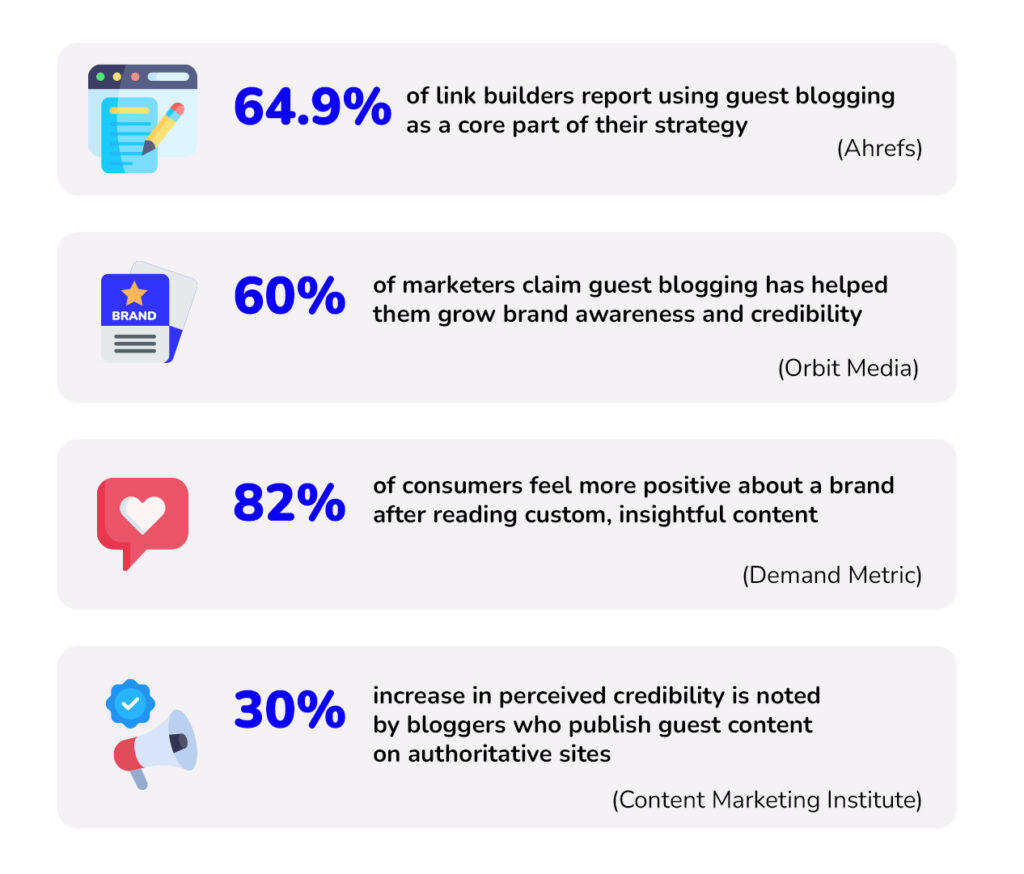
Here are the key benefits of guest posting:
Improved search engine rankings
When Google notes a link to your site from a well-established, long-running blog, it’s always a good sign. Google treats it as a kind of endorsement, such backlinks pass plenty of link juice and improve your rankings.
Increased website traffic
Publishing on popular niche websites attracts a targeted audience, increases your website traffic and generates more leads.
If this blog has existed for quite some time, it is likely that it has a community of supporters. This way, you will have the opportunity to gain access to a new audience. In addition, if this audience is warmed up enough, they may perceive the mention of you or your brand as a recommendation by default. So, the probability that they will click on the link directing to your website becomes higher.
The traffic you receive from such mentions is called referral traffic. Such traffic differs from organic traffic in that it allows you to quickly gain visibility and attract visitors.
Enhanced brand exposure
You can expand your brand’s reach and improve its visibility by guest posting on external websites.This is due to the fact that psychologically people tend to trust brands that are in the public eye.
Establishing authority and trust
You can achive a reputation as an industry expert by consistently contributing insightful content to respected websites. This establishes trust and boosts reader engagement.
Networking and relationship building
Guest posting helps you network with influential bloggers and website owners, opening doors to collaborations, partnerships and expanded promotional reach.
A wide range of collaborations and partnerships creates the impression that you’re connected with everyone and well-known in the niche. This kind of networking increases an industry community that at some point starts working for you on its own after all.
Diversified backlink profile
Guest blogging builds a diverse and authentic backlink profile that blends high-quality and keyword-rich backlinks with non-anchor text links for a more natural link-building approach.
Guest Posting Risks and Google Link Spam Rules in 2026
Guest posting itself isn’t risky, manipulative patterns are. In 2026, Google looks at intent, scale, and consistency across your backlink profile to surface any manipulation.
What Google considers manipulation:
- Publishing on unrelated sites purely for link placement
- Repeating exact-match commercial anchors across multiple guest posts
- Using the same content angle and link placement structure at scale
- Contributing to sites with no real audience, weak editorial control, or inflated metrics
How to reduce the risk of sanctions:
Risk management in guest posting comes down to making links look earned, not placed:
- Vary anchor types (brand, URL, partial match, context-based mentions)
- Spread placements across different domains, formats, and authors
- Prioritize sites with real traffic, real authors, and topical focus
- Keep link velocity stable (avoid bursts tied to campaigns or rankings)
Types of Guest Posts That Work Best for SEO
Not all guest posts send the same signals to search engines. Different formats serve different purposes. Here are the most popular types of guest posts in SEO:
| Top guest posting formats in 2026 Opinion pieces and thought leadership articles In-depth educational guides Data-driven studies and original research Case studies and real-world examples Expert roundups and curated lists |
Opinion pieces and thought leadership articles
These posts focus on insights, frameworks, or strong opinions rather than how-tos. They work best for authority and trust signals, especially in competitive niches where basic content is already saturated.
SEO value comes from editorial placement, branded or natural anchors, and frequent secondary citations. This format is ideal when you want your site referenced as a source. It works especially well for established sites, brand building, competitive SERPs.
In-depth educational guides
Long-form guides explain a process, concept, or methodology in detail. These posts perform well for topical relevance and often attract organic backlinks over time.
They support contextual links naturally because references are expected inside instructional content. This format works particularly well in B2B, SaaS, and technical niches.
Data-driven studies and original research
These posts are built around proprietary data, case results, surveys, or benchmarks. These are among the strongest guest post formats because they earn links beyond the initial placement.
Here, the main SEO value comes from citations by journalists, bloggers, and analysts who reuse the data. Even a single data-backed guest post can outperform multiple standard articles. It’s a solid choice for earning secondary backlinks and long-term citations.
Case studies and real-world examples
Case studies show how a strategy or product works in practice. They’re effective because they combine proof, narrative, and specificity (which editors favor).
From an SEO standpoint, they allow highly relevant contextual links without aggressive anchors. They’re especially useful in niches where trust and credibility matter more than volume. This format is best for SaaS and high-trust industries.
Expert roundups and curated lists
These listicles aggregate insights, tools, or perspectives around a narrow topic. Here, editors expect multiple references, which makes outbound links feel natural.
This format supports branded and contextual anchors without forcing placement. It’s pretty effective when you contribute a distinct angle, not just another item in the list. Listicles are the best place for natural link insertion and brand mentions.
How to Find Quality Guest Posting Sites
Guest posting offers a variety of opportunities to secure valuable placements for your content. Here are some effective methods for finding guest posting opportunities.
Manual outreach
Manual search for guest posting opportunities involves identifying relevant websites in your niche and reaching out to them directly. This method allows for personalized pitches and a higher chance of getting a guest post published.
You can visit niche-specific blogs and contact site owners or editors to discuss guest posting opportunities.
Social media and community engagement
Engaging with communities on social media platforms, forums, and professional networks can lead to guest posting opportunities. By participating in discussions, you can establish connections with website owners and editors.
Using specialized SEO platforms like Serpzilla
If you want to make the search for SEO guest posting opportunities much faster and more efficient, you can use platforms like Serpzilla. It gives access to websites that actively accept guest posts, with clear requirements, metrics, and placement conditions. You can focus on pitching and publishing instead of manual outreach.
Here’s a step-by-step guide to finding guest posting websites in Serpzilla, a practical part of how to get quality backlinks.
Step 1: Accessing the Serpzilla guest posting filters
Once you log in to Serpzilla, you’ll find a well-organized dashboard with your project. To proceed to website selection, click ‘Buy links’ → ‘Guest Posts’ → ‘Publisher’s Article’:

You can also select a project from the left-hand menu and then click ‘Buy Backlinks’ → ‘Publisher’s Article’:
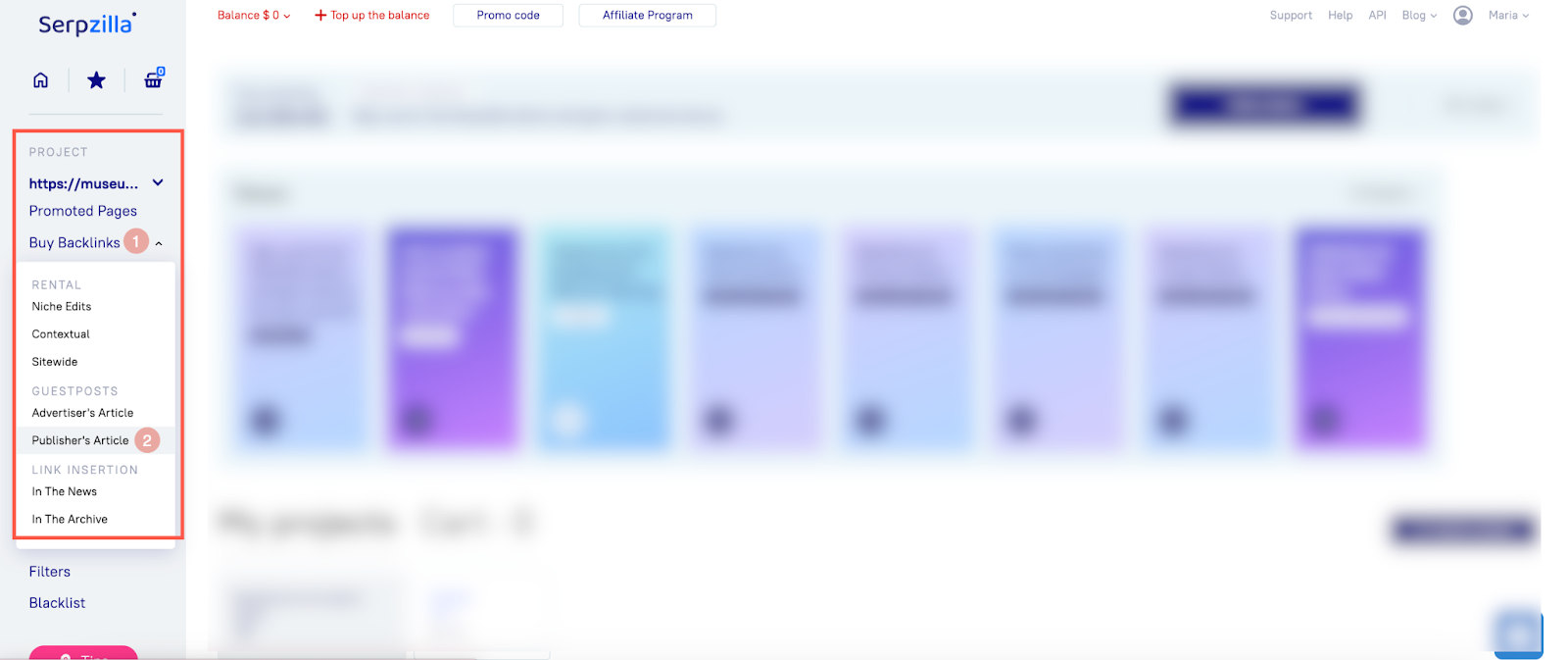
You’ll be redirected to the ‘Buy links’ webpage where you can start setting up filters.
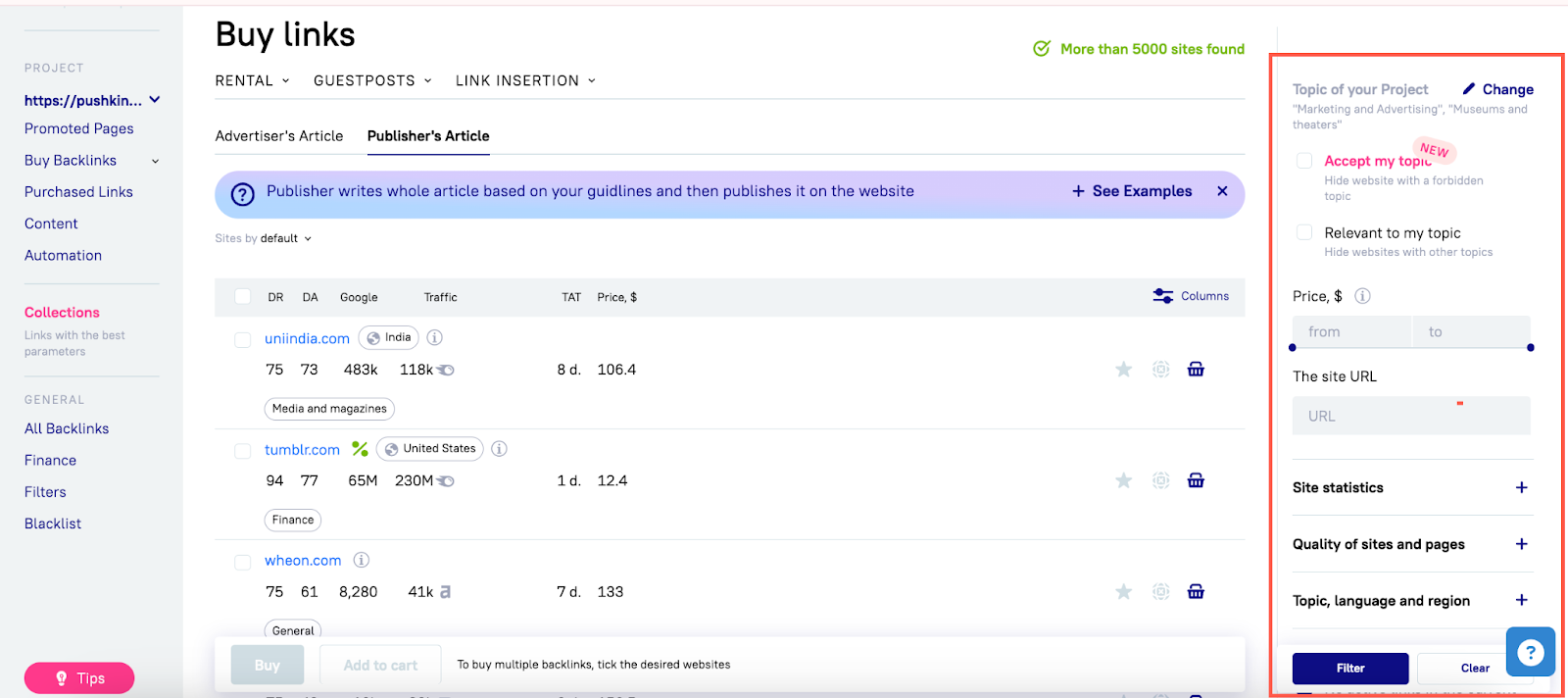
Step 2: Setting up filters for quality guest posting sites
The success of your guest posting strategy depends on targeting the right websites. Serpzilla’s advanced filters allow you to customize your search for optimal results. Here’s how to set the filters:
- Cost Range
Define your budget using the ‘Price’ filter. This ensures you find affordable options while maintaining quality. - Quality of sites and pages
- Set the ‘DR Ahrefs’ range to target high-authority websites (e.g., DA 30–80). Higher authority sites typically offer better SEO value.
- Set the ‘MOZ Spam Score’ metric to specify a maximum website spam probability level (e.g. a value up to 30% is considered a low spam score, up to 60% – medium spam score).
- Specify a minimum traffic amount. Look for sites with consistent visitor counts to maximize your reach.
- Topic, language and region
- Specify the topic to select your industry or niche, ensuring the website’s content aligns with your target audience.
- If your audience is location-specific, use the Country filter to find websites popular in your target region. For example, you can choose the United States for the American market or Spain for Spanish-speaking audiences.
- Select the desired language for the guest post to ensure alignment with your audience.
After you set all the necessary filters, click the ‘Filter’ button to continue.
Step 3: Reviewing the generated list
Once filters are applied, Serpzilla provides a curated list of websites that match your criteria. Each listing includes essential details to help you evaluate the site:
- Domain Metrics: DA, DR, traffic, and backlink profile.
- Site Description: Overview of the site’s niche and audience demographics.
Use checkboxes or the cart icon to select the websites where you are ready to place Guest Posts.
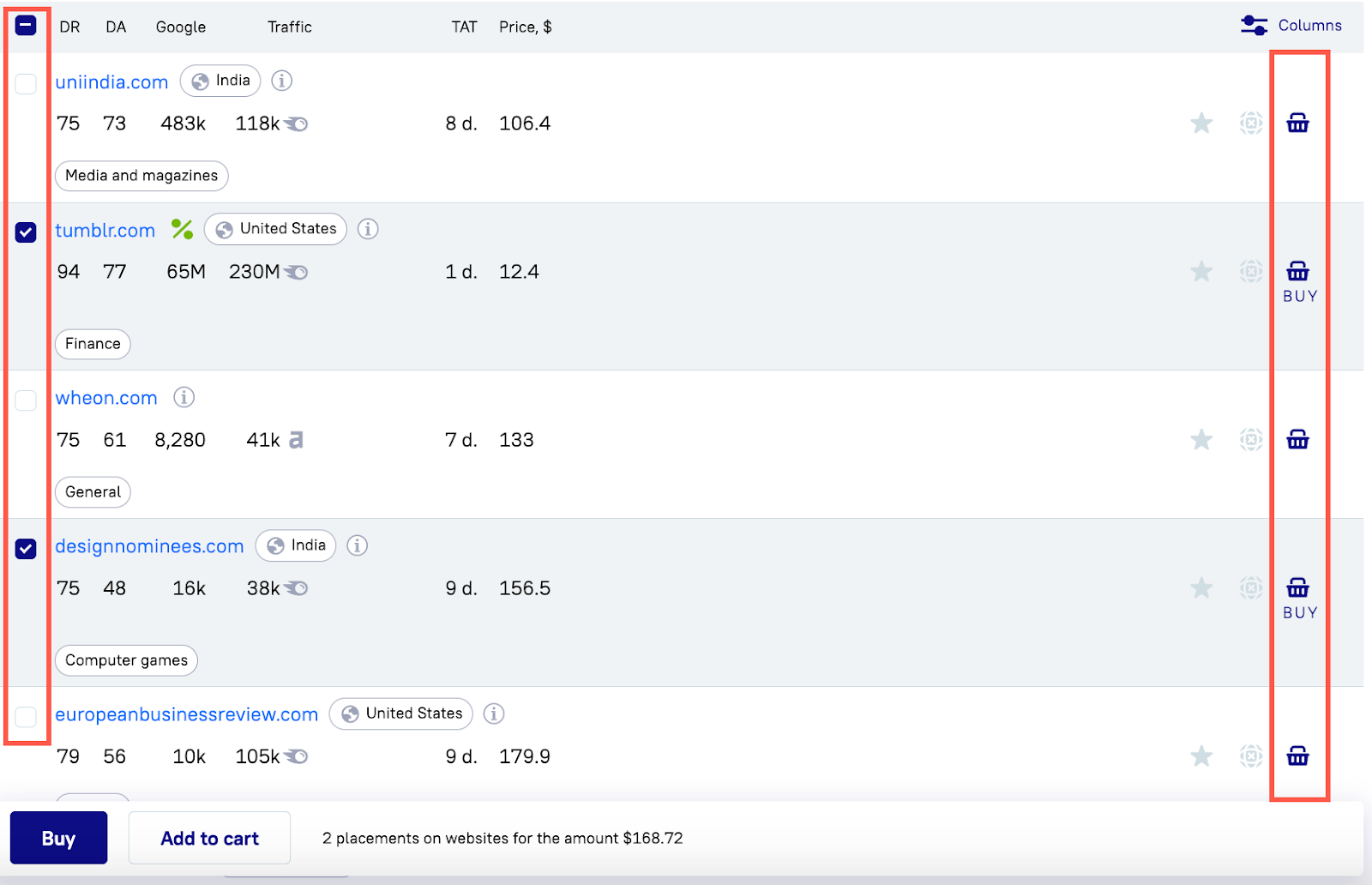
Once the websites are selected, click the ‘Buy’ button at the bottom of the page to proceed to order placement.
Step 4: Submitting a guest post
Serpzilla offers two primary options for submitting guest posts:
- Pitch and Write: Contact the webmaster with a pitch for your article. Once approved, you can craft a tailored post.
- Provide a Pre-Written Post: If you already have a high-quality article, you can submit it directly to the site owner.
The platform includes messaging tools to streamline communication with webmasters, ensuring clarity and efficiency during the collaboration process.
Step 5: Tracking and managing submissions
Serpzilla simplifies the management of your guest posting campaigns with tracking features:
- Monitor the status of your submissions.
- Track the performance of published posts, such as traffic generated and backlink effectiveness.
How to Write a Guest Post That Gets Published
Value-driven content
The foundation of a successful guest post is its ability to provide real value to the audience. Address their pain points, answer questions, or share unique insights. Focus on actionable advice and high-quality information. And don’t overdo it with volume. Over-inflated articles aren’t very effective.
37% of blogs with strong SEO results contain 2,000–3,000 words.
Source: Wix.com
Example: If you run a yoga studio and your guest post is on a blog for working mothers, you can share a series of simple relaxation exercises or stretches, which last 5-10 minutes and require no additional equipment. Mothers would appreciate practical, easy-to-follow content that they can use at home.
Audience relevance
Tailor your post to match the interests and expectations of the host site’s readers. Use SEO tools to research the website’s existing content and audience to ensure your article aligns seamlessly.
Guest posting allows you to study the composition of the blog’s audience, helping you understand how relevant they are to your target audience. This enables you to create content that can effectively engage diverse groups.
Natural placement of backlinks
For best results, build high-quality backlinks that naturally integrate into your content. Since you often control or at least approve the content of guest posts, you have the flexibility to create anchor texts and placements that align naturally with the flow of the content.
This ensures the link placement is as organic as possible, and maintains the credibility and engagement of your post. Avoid unnatural or overly promotional link placements, as they can negatively impact your content’s authenticity.
Readability
Write in a language that is easily understandable for the blog’s audience — avoid overcomplicating your content. Structure your text effectively by breaking it into digestible sections, and avoid posting lengthy blocks of text.
Also, add visuals, infographics, and support your claims with relevant statistics to raise engagement and make your content more informative.
People retain 65% of info from images after 3 days, versus 10% from text.
Source: Hubspot.
SEO Optimization
Incorporate relevant keywords naturally within the post to improve its discoverability without compromising readability. Ensure the meta description, alt texts, and headline are optimized for search engines.
But, it’s important to remember not to over-optimize. Overusing keywords can lead to a negative impact on both user experience and search engine rankings.
Guest Post Link Placement and Anchor Strategy
Where and how you place links inside a guest post matters more than how many links you get.
Where to place links in SEO guest posts
In-body contextual links perform best. Links placed inside the main content (especially within explanatory or reference-heavy paragraphs) carry the strongest signals.
Avoid:
- Author bio–only links (low weight, often ignored)
- Footer or sidebar links (treated as boilerplate)
- Forced “resources” blocks added only to host links
The safest placements appear where a reference is logically expected, not where SEO traditionally wants it.
Pro tip: One primary link per guest post is optimal. Two can work if they point to different pages and serve different purposes, but anything beyond that increases scrutiny. More links don’t equal more value. They can dilute context and make intent look transactional.
Anchor text strategy that works in 2026
Anchor diversity is non-negotiable. Over-optimized anchors are still one of the fastest ways to trigger link devaluation. Here’s the best-performing anchor mix:
- Branded anchors (brand name or domain)
- Partial-match anchors (descriptive phrases, not exact keywords)
- Natural anchors (“this guide,” “this approach,” “learn more”)
- Naked URLs (especially in data or reference-heavy content)
Pro tip: Exact-match commercial anchors should be rare, rotated carefully, and never repeated across multiple guest posts.
Matching anchor to page intent
Anchor text must reflect the intent of the target page:
- Informational pages → descriptive or neutral anchors
- Commercial pages → brand-led or soft partial matches
- Category or service pages → contextual mentions, not sales language
When anchor intent mismatches page intent, Google often discounts the link entirely.
How to Promote a Guest Publication After It’s Published
Publishing the guest post is only half the work. Most of the SEO value comes from what happens after it goes live: how quickly it’s discovered, referenced, and reinforced.
| Top promotion tactics post publication Re-index and speed up discovery Distribute across relevant channels Build supporting links to the guest post Monitor and reuse high-performing placements |
Re-index and speed up discovery
As soon as the post is live, make sure it gets crawled fast:
- Request indexing in Google Search Console (if you have access)
- Link to the post from an already indexed page on your own site
- Share it on at least one active platform where Google regularly crawls (LinkedIn, X, niche communities)
Early crawling increases the chance that the link is evaluated before other competing signals appear.
Distribute across relevant channels
Promotion should match the topic as much as it does your brand:
- Share it on LinkedIn with context, not “we published a guest post”
- Post it in niche Slack groups, Discords, or forums where the topic fits naturally
- Send it to partners or peers mentioned in the article (this often triggers reshares)
Build supporting links to the guest post
One of the strongest amplifiers is linking to the guest post itself. This helps Google treat it as a referenced resource rather than an isolated placement.
Serpzilla helps you do this naturally. You can place a small number of contextual links from relevant sites pointing to the guest article, strengthening its authority and indirectly boosting the value of the link inside it. In other words, you’re reinforcing the page that carries your backlink.
Pro tip: When promoting a guest post via Serpzilla, prioritize sites that are topically adjacent to the host publication, not identical to it. This creates a natural citation network around the guest article.
Monitor and reuse high-performing placements
To choose the best ones, track:
- Indexation status
- Traffic to the guest post
- Whether it attracts secondary backlinks
Strong placements are worth revisiting. If a site consistently performs well, it’s a candidate for future guest posts, mentions, or deeper collaboration.
How to Track the Effectiveness of Guest Posts: Metrics to Watch
Effective guest posts improve visibility gradually, stay live, and contribute to a stable, natural-looking backlink profile. That’s why you need to monitor several key metrics to see if your guest posting strategy is working.
Indexation status of the guest post
If the page isn’t indexed, the link has no impact.
- Benchmark: Indexed within 3–10 days and still indexed after 30+ days.
- How to monitor: Use site:URL search in Google or check URL Inspection in Google Search Console (if you have access).
Link placement and retention
The link must stay in the main content and remain unchanged.
- Benchmark: Link still live and unchanged at 30, 60, and 90 days.
- How to monitor: Manual checks + backlink monitoring tools (Ahrefs, Semrush, or Serpzilla link tracking).
Referral traffic from the guest post
Traffic confirms real visibility and editorial value.
- Benchmark: 5–50 visits/month for niche sites; 50–200+ for larger publications.
- How to monitor: Google Analytics → Referrals (or GA4 traffic acquisition report).
Ranking trend of the linked page
Rankings usually shift gradually after publication.
- Benchmark: Initial movement in 2–4 weeks; clearer trend in 6–8 weeks.
- How to monitor: Keyword tracking tools (Ahrefs, Semrush, or GSC performance report).
Search impressions in Google Search Console
Impression growth often appears before ranking changes.
- Benchmark: Impression increase within 14–30 days for related queries.
- How to monitor: Google Search Console → Performance → Search results.
Secondary backlinks to the guest post
Links pointing to the guest article amplify its authority.
- Benchmark: 1–3 secondary links within 2–3 months.
- How to monitor: Backlink tools by tracking the guest post URL as a target page.
Case Study Examples of Successful Guest Posts
Guest posting is akin to a specific marketing strategy, with the potential for substantial benefits for both guest writers and host blogs when executed with finesse. Within this context, let’s delve into illuminating instances of guest posts that have unequivocally excelled:
Gregory Ciotti’s Impact on Help Scout: Ciotti’s article delving into the psychology of colour in marketing resonated profoundly with a diverse readership, propelling the post into the realm of virality. This underscores the impact of well-researched, uniquely presented content.
Leo Widrich’s Insight on Search Engine Watch: Widrich’s contemplation of the importance of psychology in content marketing laid bare the power of immersive narratives in digital marketing endeavors.
Brian Dean’s Strategy on Backlinko: Brian Dean’s article, spanning numerous platforms and underpinned by his distinctive ‘Skyscraper Technique’ for high-value content, epitomizes a triumphant approach to guest posting.
Joel Klettke’s Contribution to ConversionXL: Klettke’s contribution on copywriting strategies provided readers with a comprehensive roadmap, cementing its status as a key resource in the sector. These guest posts serve as vivid demonstrations of the remarkable influence wielded by properly considering content placement.
These exemplary guest posts illustrate the profound impact of strategic content placement.
Mistakes to Avoid in Guest Posting
The realm of guest posting offers a valuable strategy, but as with any strategy, potential pitfalls lurk. Here, we outline a catalogue of prevalent mistakes often encountered by writers and marketers, along with guidance on how to sidestep them:
- Neglecting the Guidelines of the Host Blog: Each blog boasts its distinct rules encompassing style preferences, content length, and alignment of thematic guidelines. Not paying attention to these directives can swiftly lead to rejection of your submission.
- Delivering Subpar Content: The hallmark of a guest post should be excellence and expertise. Permitting anything less than this to be published not only diminishes your standing but also fails the readers seeking substantive value from an expert standpoint.
- Deploying Generic Pitches: Employing a one-size-fits-all pitch tends to miss the point of reaching various audiences. Customization is key—craft pitches that resonate with the nuances of each blog, showcasing both your experience and research in a way that fully aligns with their readership.
- Excessive Promotion: While guest posts can serve as channels for marketing operations, the paramount objective remains in securing value. Drowning the narrative in overt promotions of products, services, or personal branding can overwhelm the audience.
- Neglecting SEO Principles: Even within the domain of third-party blogs, adherence to SEO principles holds sway. Infuse keywords organically, structure content with apt headings, and optimize for search engines to ensure discoverability.
- Neglecting Reader Engagement: Neglecting to respond to readers’ comments signifies a missed opportunity. Akin to extending a virtual handshake, this engagement fosters a bond with the audience and can potentially garner future prospects.
- Neglecting Cross-Promotion: Upon your guest post’s publication, leveraging your own digital channels for cross-promotion—audio on social media, newsletters, and website—brings in amplified traffic and bolsters the credibility of both you and the hosting blog.
- Foregoing Analytical Scrutiny: Positive insights from post-performance analytics proves pivotal. Ascertain resonant topics, gauge the efficacy of calls-to-action, and discern traffic dynamics, equipping you with knowledge to fine-tune future guest posts.
At its core, guest posting epitomizes reciprocity. Hosting blogs are enriched with quality content, while you reap the rewards of heightened visibility and a position of authority in your area of expertise. Mindful avoidance of these entrenched missteps ensures an optimal result throughout the collaborative process.
FAQ
What’s the difference between guest posting and sponsored content?
Guest posting is editorial-led: you contribute useful content, and the link is a natural part of it. Sponsored content is payment-led, where placement is the main goal.
How long does it take to see SEO results from guest posting?
Most sites see movement in 4–12 weeks, depending on domain authority, crawl frequency, and existing link profile. Guest posts strengthen trust and relevance signals gradually, not overnight. Sudden ranking jumps are usually coincidental rather than caused by a single link. That slow-burn effect is typical of link acquisition more broadly, which is why understanding how long backlinks take to work helps set more realistic expectations.
How many guest posts do you need per month to see progress?
There’s no fixed number, but 2–5 strong placements per month is enough for most established sites. New or low-authority sites may need closer to 4–8 placements to build momentum.
Do guest posts still work if the link is nofollow?
Yes, just differently. Nofollow links don’t pass PageRank directly, but they support trust, natural link profiles, and brand citations. They also often lead to secondary dofollow links when content gets referenced elsewhere. Besides, a backlink profile without nofollow links looks unnatural.
Can AI-written guest posts work if edited by a human?
Yes, if AI is used for drafting, not publishing. Human editing is needed to remove generic phrasing, add real examples, and match the site’s tone. Editors can spot raw AI instantly, but well-edited drafts publish without issue.