Link building outreach is one of the core SEO processes for earning relevant backlinks through direct communication with site owners, editors, and bloggers. Done properly, it turns relevant websites into long-term link partners and converts content into measurable SEO growth. Done poorly, it burns domains, damages brand reputation, and wastes weeks of effort.
This guide walks through how to approach outreach strategically: who to contact, what to pitch, how to follow up, and how to turn replies into real placements.
What is Link Building Outreach?
Link building outreach involves reaching out to relevant websites, blogs, and businesses to introduce your content and propose collaboration. The goal is to secure backlinks through guest posts, content mentions, or other arrangements. Unlike mass emailing, effective outreach is personalized and value-driven, aiming to build genuine relationships.
Here’s where people often get confused. Outreach is the process. Guest posting, digital PR, niche edits, and link insertions are formats.
- Guest posts require pitching and writing new content from scratch
- Digital PR focuses on newsworthy assets and media coverage
- Niche edits (link insertions) mean placing your link into existing content
Outreach is the negotiation layer behind all of them: the emails, follow-ups, positioning, and value exchange that make those placements happen.
In short, outreach isn’t a tactic but rather the engine that powers multiple link-building tactics.
Why Is Link Building Outreach Important?
Outreach is a strategic approach that goes beyond mere link building. It’s about forging meaningful relationships, boosting brand visibility, prioritizing quality over quantity, offering authentic value, and maintaining a diverse backlink profile.
By incorporating some essential elements into your outreach strategy, you can enhance your brand’s online presence and authority while establishing lasting connections within your industry. Let’s take a look at how outreach assists in link building.
Relationship building
Outreach involves proactively reaching out to individuals, publishers, bloggers, and businesses within your industry or niche. By establishing connections and nurturing relationships, you can create a network of partners who are willing to collaborate and support your content initiatives. These partnerships can extend beyond one-off interactions, leading to long-term collaborations and opportunities for guest posting.
This approach not only diversifies your content but also enhances your brand’s reputation through association with reputable sources.
— Sergei Pankov, CEO of Serpzilla
Enhanced brand visibility
When you engage in outreach efforts and secure placements on established platforms, you expose your content to a broader and often more engaged audience. This exposure leads to increased brand visibility as your content reaches individuals who might not have encountered your brand otherwise. As these platforms already have a dedicated following, your content has the potential to be shared and engaged with by a larger number of people, contributing to greater brand recognition and awareness.
Increased backlink quality
Outreach is not about casting a wide net and securing as many backlinks as possible. Instead, it focuses on identifying and targeting authoritative websites within your industry or niche. These are websites that are recognized as credible and trustworthy by both users and search engines. By emphasizing high-quality backlinks from such sources, your website gains more credibility in the eyes of search engines like Google. These authoritative backlinks carry more weight and contribute significantly to your website’s search engine ranking. If you want a clearer framework for evaluating placements, our guide on how to get high-quality backlinks breaks down the criteria and strategies that matter most.
Authenticity and value
Effective outreach involves a genuine value exchange. When you approach potential partners, you offer them valuable content or contributions that align with their audience’s interests and needs. In return, you gain exposure and backlinks. This authenticity in your outreach efforts leads to successful collaborations and builds credibility for your brand. When your content provides real value to the target audience, it establishes your brand as a trustworthy and knowledgeable authority within the industry.
Diverse backlink profile
A diverse backlink profile is a big deal when you want ot build a healthy and natural online presence. Targeting a variety of websites through outreach efforts helps ensure that your backlink profile is well-rounded. This means acquiring backlinks from different types of sources, including industry-specific websites, news sites, blogs, and more. Search engines view a diverse backlink profile as a sign of organic growth and genuine interest from various sources, which positively impacts your search engine ranking and overall online visibility.
Types of Link Outreach Campaigns
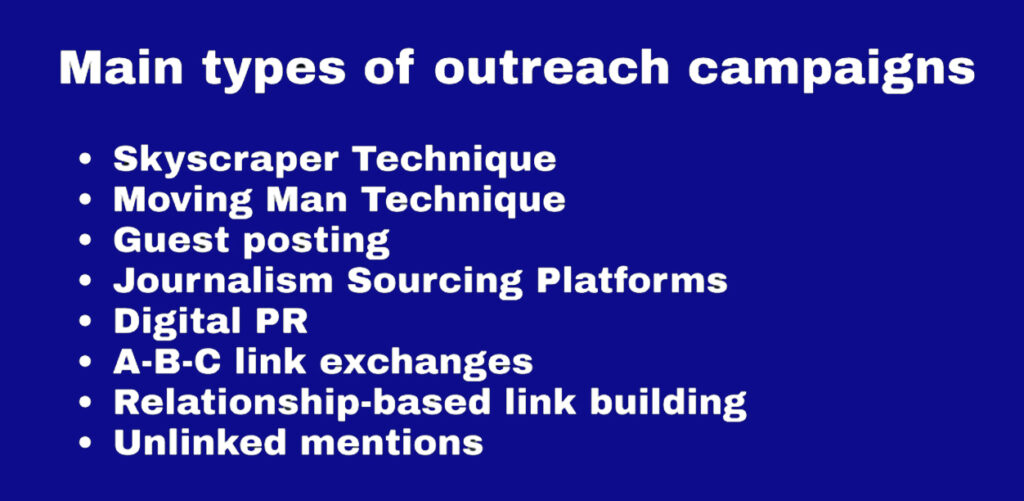
Link-building outreach can take different forms. It’s a framework, and the strategy you choose depends on your resources, niche competitiveness, content quality, and timeline.
Below are the most common outreach campaign types, and when each one makes sense.
The Skyscraper Technique
The Skyscraper Technique is about improving existing high-performing content and pitching your superior version to sites that already link to similar resources.
How it works:
- Identify a popular article with a strong backlink profile.
- Create a more updated, data-backed, or comprehensive version.
- Reach out to websites linking to the original and suggest your improved resource.
When to use it:
- You have strong content production capabilities
- You’re targeting informational keywords
- The niche has outdated but well-linked content
Reality check: Here, success depends entirely on how much better your version actually is.
The Moving Man Technique
This method targets broken, outdated, or rebranded resources.
How it works:
- You find pages that reference defunct companies, tools, or removed URLs.
- You create a relevant replacement resource.
- And then you reach out, suggesting your link as a substitute.
When to use it:
- In SaaS, tech, and fast-changing industries
- When competitor brands shut down or pivot
- If you can quickly produce replacement content
It’s efficient because you’re solving a real problem: broken links hurt site quality.
Guest posting
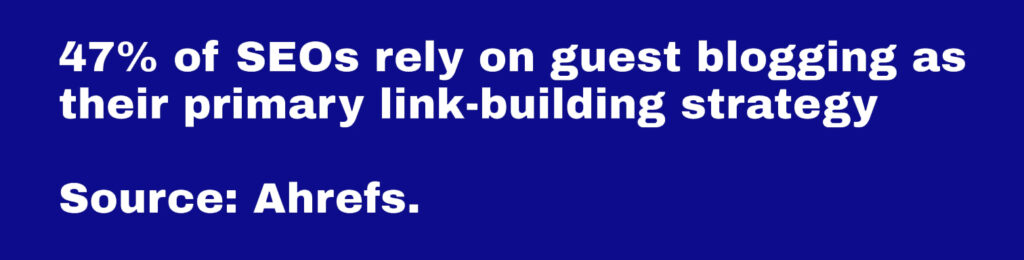
Guest posting involves pitching and writing original content for another website in exchange for a backlink.
When to use it:
- You need contextual link building opportunities on relevant domains
- You want control over anchor text and placement
- Your brand benefits from visibility in industry blogs
It requires:
- Prospect research
- Topic pitching
- Editorial alignment
- Content creation
It’s scalable but resource-intensive. That’s why many teams combine manual outreach with platforms like Serpzilla to streamline placement sourcing. Instead of spending weeks negotiating with unresponsive editors, you can filter vetted domains by niche, DR, traffic, language, and GEO, and secure contextual placements faster. This reduces operational drag and gives you predictable inventory when timelines are tight. For teams using outreach to land editorial placements consistently, a solid understanding of guest posting for SEO helps set better expectations around prospecting, pitching, and placement quality.
We’ll take a closer look at how to use Serpzilla effectively later in this guide.
Journalism sourcing platforms
Platforms like HARO-style networks connect journalists with expert sources.
How it works:
You provide quotes, data, or commentary. If selected, you earn editorial backlinks from media publications.
When to use it:
- You have internal experts
- You can respond quickly
- You’re targeting authority and brand credibility
Competition is high, but links are often powerful.
We worked with a cybersecurity SaaS client who got great results with HARO. They weren’t trying to sell journalists on their product. They simply had people inside the company who could explain security risks clearly and quickly. Over three months, the team responded to around 40 journalist requests on data breaches, password safety, and AI-related threats. Six of those responses were picked up, earning the client four editorial backlinks from relevant media articles. This made the outreach feel natural since the journalist got a strong expert quote, and the company earned a trusted backlink without forcing a sales pitch into the conversation. This is exactly where journalism sourcing works best: when you have real expertise, a fast response process, and something worth adding to the story.
— Egor Golovin, CCO of Serpzilla
Digital PR
Digital PR campaigns focus on creating newsworthy assets (data studies, surveys, reports, interactive tools) and pitching them to media outlets.
When to use it:
- You have a budget for research or data analysis
- You want high-authority, editorial links
- Brand positioning matters as much as SEO
Digital PR links can move authority significantly, but campaigns require strong angles and professional pitching.
A-B-C link exchanges
A-B-C exchanges avoid direct reciprocal linking.
Example:
- Site A links to Site B
- Site B links to Site C
- Site C links to Site A
When to use it:
- Within trusted networks
- In moderate-competition niches
- When transparency and relationship trust exist
Overuse increases risk, so you should keep exchanges natural and limited.
Relationship-based link building
This is long-term outreach.
How it works:
- You build connections with editors, founders, and marketers, engage on social platforms, and collaborate over time. Links happen organically through co-marketing, expert roundups, partnerships, and content collaborations.
When to use it:
- In tight-knit industries
- When long-term SEO growth matters more than quick wins
Unlinked mentions
Sometimes websites mention your brand but don’t link to it.
How it works:
- You monitor brand mentions and reach out politely, requesting a link addition.
When to use it:
- Your brand already has visibility
- You’ve invested in PR or content marketing
- You want quick-win opportunities
One of the easiest gains I’ve seen came from an online furniture retailer that had already been mentioned in gift guides, interior design roundups, local media articles, and supplier announcements. When we checked the mentions, we found about 60 pages that named the brand. Around 20 of them had no link back to the website. That gave us a clean outreach list: no cold pitch, no begging for coverage, just a short note asking editors to link the existing brand mention so readers could view the collection or original source. Within three weeks, 7 websites added the link. It wasn’t a huge campaign, but with unlinked mentions, outreach simply turns part of pre-earned attention into concrete backlink value.
— Egor Golovin, CCO of Serpzilla
How Link Building Outreach Works (Step-by-Step Workflow)
Link outreach only works when it’s treated like an operational process. Here’s how to run it properly.
Step 1. Reverse-engineer what earns links effectively in your niche
Before building a prospect list, audit the following:
- What type of content earns links in your vertical?
- What anchor patterns are common?
- Are links mostly guest posts, insertions, citations, or PR-driven?
That’s where competitor data will come in handy. Pull 3–5 top competitors into Ahrefs or Semrush and analyze:
- Their referring pages (not just domains)
- Link context (editorial vs sidebar vs author bio)
- Content type receiving links
If competitors are earning contextual links inside listicles and comparison posts, pitching ultimate guides won’t convert. Recognize effective patterns and build on them.
Step 2. Define the page and link intent
Next, get very clear on:
- Which page you are building links to
- What anchor types you need
- What the goa isl (rankings, authority, referral traffic, brand mentions, etc.)
If you don’t define intent, outreach will inevitably become chaotic. You might pay too much attention to DR instead of relevance and end up with mismatched placements.
Here’s a simple tip: segment campaigns by page type (commercial, informational, homepage), it will help you adjust messaging accordingly when you get down to outreach proper.
— Sergei Pankov, CEO of Serpzilla
Step 3. Choose the relevant websites before you pitch
Before you collect contacts, decide which websites are worth reaching out to. A good outreach prospect should be topically relevant, editorially active, and likely to accept third-party references without looking like a link farm.
Start with these checks:
- Topical fit. Does the site regularly cover your niche, audience, or adjacent topics?
- Content quality. Are the articles useful, original, and written for real readers?
- Editorial activity. Has the site published or updated content in the last three to six months?
- Outbound link behavior. Does the site naturally link to external sources, tools, studies, partners, or expert contributors?
- Placement context. Can your link realistically fit inside the article body, not just in an author bio, footer, or random resource list?
- Traffic and visibility. Does the site have stable organic traffic and rankings, or does it look inflated by irrelevant pages?
- Link profile health. Does the domain have natural referring domains, clean anchors, and no obvious spam spikes?
Avoid sites that publish everything, cover unrelated topics in bulk, have thin AI-generated posts, sell obvious “write for us” placements at scale, or place outbound links in unnatural contexts. These domains usually add little value and can weaken the quality of your backlink profile. If you wouldn’t want your brand mentioned on that site without a backlink, it probably isn’t a good outreach target.
Pro tip: If you’re scaling across niches or GEOs, Serpzilla helps you validate domain metrics, traffic quality, and topical fit before outreach even begins, which reduces wasted emails dramatically.
Step 4. Build a contactable prospect list
Outreach efficiency starts with list quality. Most lists look impressive and convert poorly.
To avoid that, filter prospects by:
- Recent content updates (last 3–6 months)
- Visible author/editor names
- Existing outbound links to third parties
- Clean topical alignment
Then, figure out who should actually receive the pitch. The right contact depends on the campaign type and the site structure.
- For media publications, pitch the editor or section editor: they usually control updates, contributor submissions, and source additions.
- For blog posts written by named contributors, the author can be a good first contact, especially if you’re suggesting a quote, correction, updated stat, or useful resource for their own article.
- For small niche blogs, directories, resource pages, or independent websites, the site owner is often the best contact since they manage both content and publishing decisions.
- For company blogs or partner pages, look for someone in content, marketing, partnerships, or PR.
Avoid sending outreach to every email you can find. A generic inbox might work for small sites, but for larger publications it usually gets ignored. Your goal is to find the person closest to the page you want to improve or the decision you want them to make. This alone can lift response rates because the pitch lands with someone who understands the content context.
— Sergei Pankov, CEO of Serpzilla
Step 5. Choose the right outreach angle per prospect
One template does not fit all. Personalize like your life depends on it (your SEO success might).
Most importantly, match your pitch to what the site already does:
- If they publish expert roundups, pitch commentary
- If they update statistics-heavy posts, offer fresh data
- If they frequently update listicles, propose inclusion
- If they already link to competitors, suggest a better resource
Your email should feel like a continuation of their editorial strategy, not an interruption.
Pro tip: Build rapport by engaging with your prospects on social platforms before reaching out. This soft introduction can make your outreach more familiar and welcomed.
Step 6. Ask for backlinks the right way
Simply asking for a link is often a bad idea. The correct approach is to suggest an editorial improvement.
Structure your ask around the Moving Man technique, but this one doesn’t require a broken link:
- Reference a specific article section.
- Find a gap (outdated stat, missing angle, broken link).
- Offer your content as an enhancement.
- Keep it under 120 words.
This way, you’re offering value, and your ask feels much more appropriate.
Step 7. Personalize outreach at scale
We already mentioned that personalization is key, but it doesn’t mean you need to write every email from scratch (that’s how teams burn out after 50 sends).
Build a controlled system where the depth of personalization matches the value of the prospect.
Start by prioritizing your list:
- High-authority, high-relevance domains deserve manual customization. For those, reference a specific paragraph, mention something the author recently published, or connect your pitch directly to their editorial angle.
- Mid-tier prospects can use structured templates with dynamic fields: article title, topic cluster, competitor reference, and content gap. The email feels tailored because the logic behind it is segmented.
- Lower-priority prospects can receive lighter personalization. Name, relevant article mention, and niche-specific angle will be enough.
Pro tip: Even basic personalization works. Adding the recipient’s first name can boost response rates by 17%, and it takes seconds to implement.
Use tags for more clarity:
- Topic cluster
- DR range
- Content type
- Competitor-linked flag
Step 8. Control the follow-up timeline
Remember that most placements happen after the second touch? When you send your initial email, assume it won’t be answered immediately. Editors are busy, and your message is competing with dozens of pitches.
Use this simple follow-up framework:
- Day 0: Initial email
- Day 4–5: Short reminder
- Day 10–12: Final check-in
Keep follow-ups under 40 words. Don’t resend the whole pitch. Just reopen the loop. Outreach fails less because of bad pitches and more because people stop too early.
Pro tip: Timing matters. Midweek outreach (Tue–Thu) drives 23% more responses, so you can stack the odds before you even hit send.
Professional Outreach Email Templates and Examples
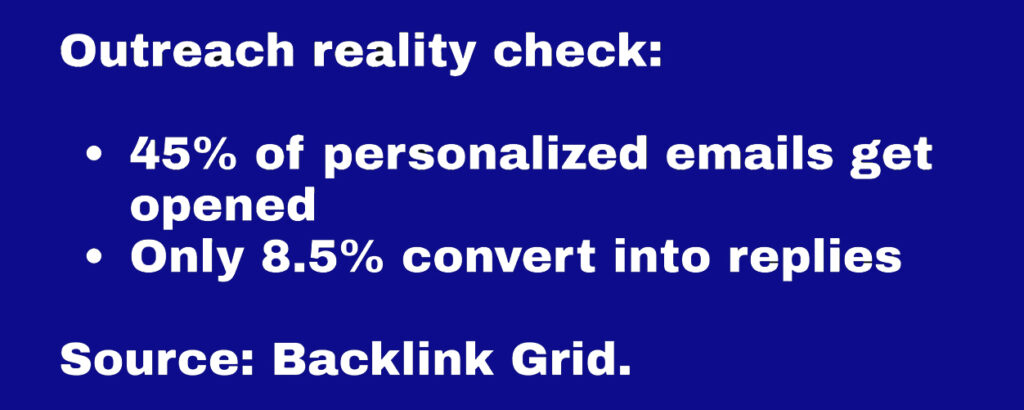
You can try these proven outreach formats for the three most common link-building scenarios, each with a practical example.
Content outreach
When to use:
- You’ve published a high-quality article, dataset, or guide that improves on existing content.
Template:
Subject: Quick addition to your [Article Topic] guide
Hi [Name],
I was reading your article on [Topic], especially the section about [Specific Section].
We recently published a resource covering [Specific Angle / Updated Data / Unique Insight]. It includes [1 short differentiator].
If you’re updating the piece, this might strengthen that section.
Would you be open to reviewing it?
Best,
[Your Name]
Example:
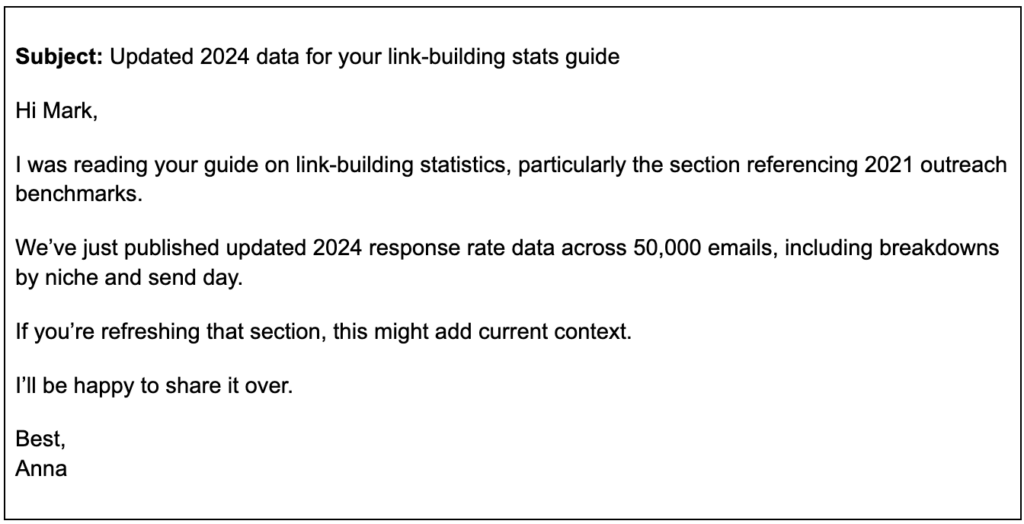
This template works because each part has a clear job:
- The subject line is specific enough to show the email is about an existing article, not a random bulk pitch.
- The opening line proves you looked at the page and gives the recipient a reason to keep reading.
- The reason for reaching out is tied to a concrete section of their content, which makes the pitch feel relevant instead of opportunistic.
- The value statement explains what your resource adds.
- Finally, the CTA is low-pressure. You’re not demanding a link or pushing for a commitment but simply asking whether they’re open to reviewing the resource. This makes the email easier to say yes to and less likely to feel like spam.
Resource page outreach
When to use:
- You’ve found a curated list or a tools page that fits your content perfectly.
Template:
Subject: Resource suggestion for your [Page Title]
Hi [Name],
I came across your curated list of [Topic] resources.
We recently created a [Tool / Guide / Study] focused on [Specific Outcome]. It might be a useful addition to your list, particularly for readers interested in [Angle].
Would you consider reviewing it for inclusion?
Thanks,
[Your Name]
Example:
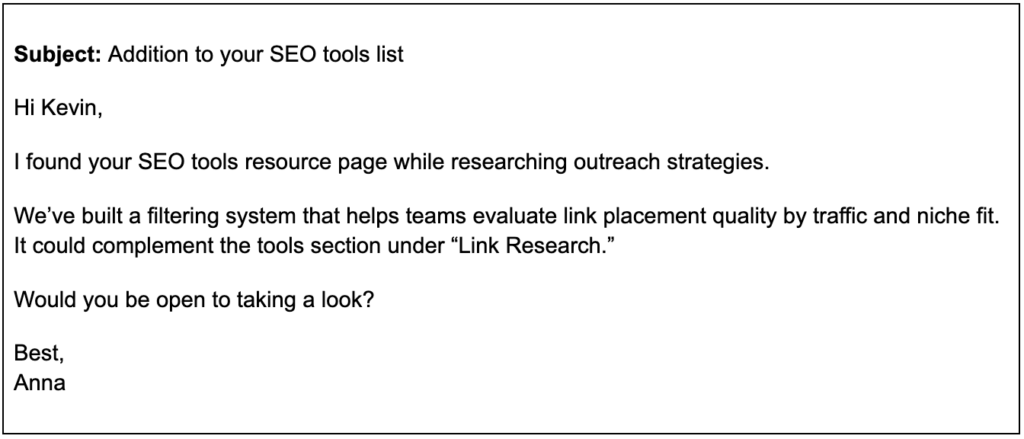
This email matches the way resource pages are built. They exist to collect genuinely useful links around one topic.
- The subject line makes the request clear immediately, so the recipient knows you’re not asking for a guest post, partnership, or vague collaboration.
- The opening line shows that you found a specific curated list and understand what it covers.
- The reason for reaching out connects your asset to the page’s existing topic, instead of forcing an unrelated link opportunity.
- The value statement explains why the resource belongs there: it helps readers solve a specific problem, compare options, access data, or go deeper on a relevant subtopic.
- The CTA stays editorial-friendly. You’re asking them to review the resource for possible inclusion without pressuring them to add a link immediately.
Contribution outreach (guest posting)
When to use:
- You want to contribute original content to a relevant publication.
Template:
Subject: Contribution idea for [Site Name]
Hi [Name],
I’ve been following your content on [Topic], especially your recent piece on [Specific Article].
Would you be open to a guest contribution?
Here are a few topic ideas tailored to your audience:
– [Idea 1]
– [Idea 2]
– [Idea 3]
Each would include actionable insights and original examples.
Let me know if one resonates.
Best,
[Your Name]
Example:
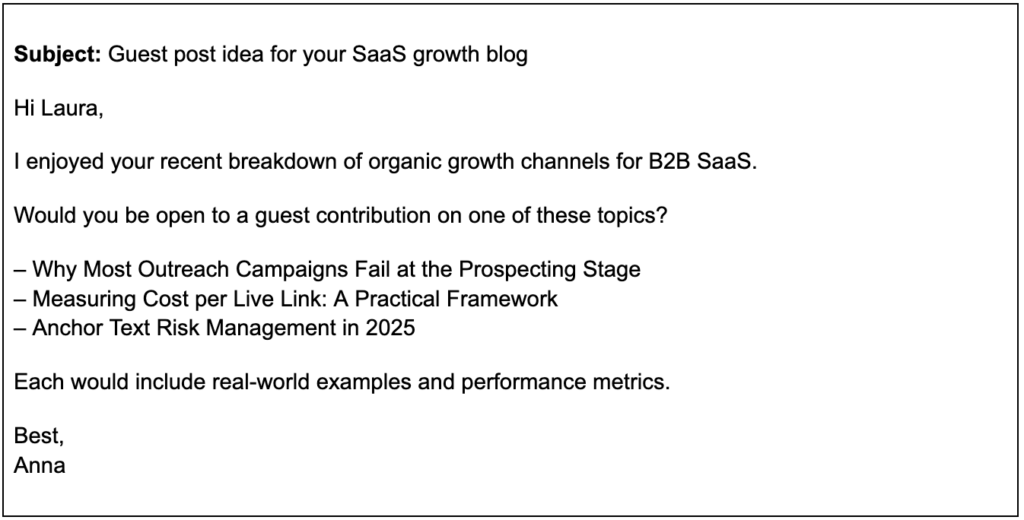
This template is built around editorial fit, not self-promotion.
- The subject line is direct and easy to sort because it tells the editor exactly what the email is about.
- The opening line gives context and shows that the pitch is based on their actual content, not a scraped domain list.
- The main ask comes early, which matters because editors should not have to dig through three paragraphs to understand the offer.
- The topic ideas do the heavy lifting: they show range, relevance, and whether you understand the publication’s audience.
- The value statement helps separate the pitch from generic guest post requests by promising practical insight and original examples, not recycled SEO filler.
- The CTA is simple and flexible, giving the editor room to choose, reject, or suggest a different angle.
If you want a deeper breakdown of additional outreach angles, see our guide on 10 email outreach templates that work.
Email Outreach Tools for Link Building
There are several tools for effective link-building outreach management. Here are our top picks:
Serpzilla
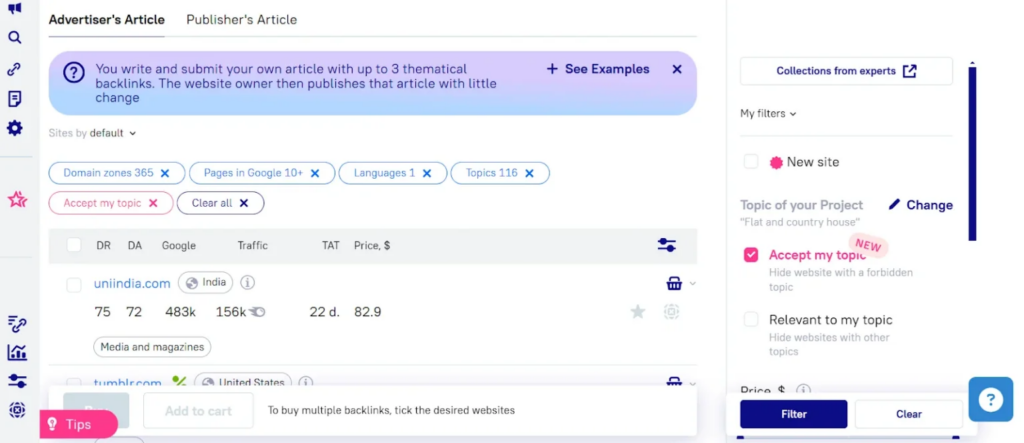
Serpzilla is a fantastic tool when you want to turn outreach research into placement research. You can easily see:
- which domains fit the niche
- what kind of link context they can provide
- how strong the page/site looks
- whether the placement can be managed after it goes live
In other words, Serpzilla supports the execution side of link building, from choosing donor sites to placing links and managing campaigns. You get a predictable link acquisition process with automated link placement, large-scale page selection, placement guarantees, and backlink control.
For example, Serpzilla shared a case study of a food and wine business in Vietnam that needed a more consistent way to build relevant links. By using the platform to run a targeted campaign, the business increased its referring domains from 20 to 50 in the first month, while organic traffic later grew to roughly 1,500 monthly visitors. After two years, Ahrefs data showed monthly organic traffic rising from 7 to 541 visits.
Pitchbox
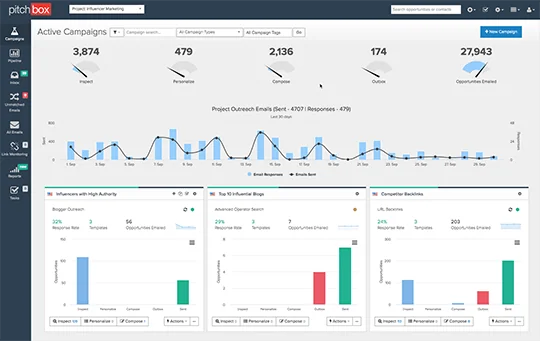
Pitchbox is built for those who run outreach as a real pipeline with prospecting, contact discovery, email sequences, follow-ups, reporting, and relationship history in one place.
It’s a strong choice for agencies or in-house SEO teams that send outreach at scale but still need campaign structure and visibility into what is working. Pitchbox positions itself around link prospecting, email management, SEO CRM, outreach, and backlink reporting. You can also take advantage of sequenced templates and automated follow-ups.
The main benefit is not automation in and of itself, though. You can see which angles, sites, contacts, and follow-up steps produce real replies instead of pulling the data manually from your inbox.
Mailshake
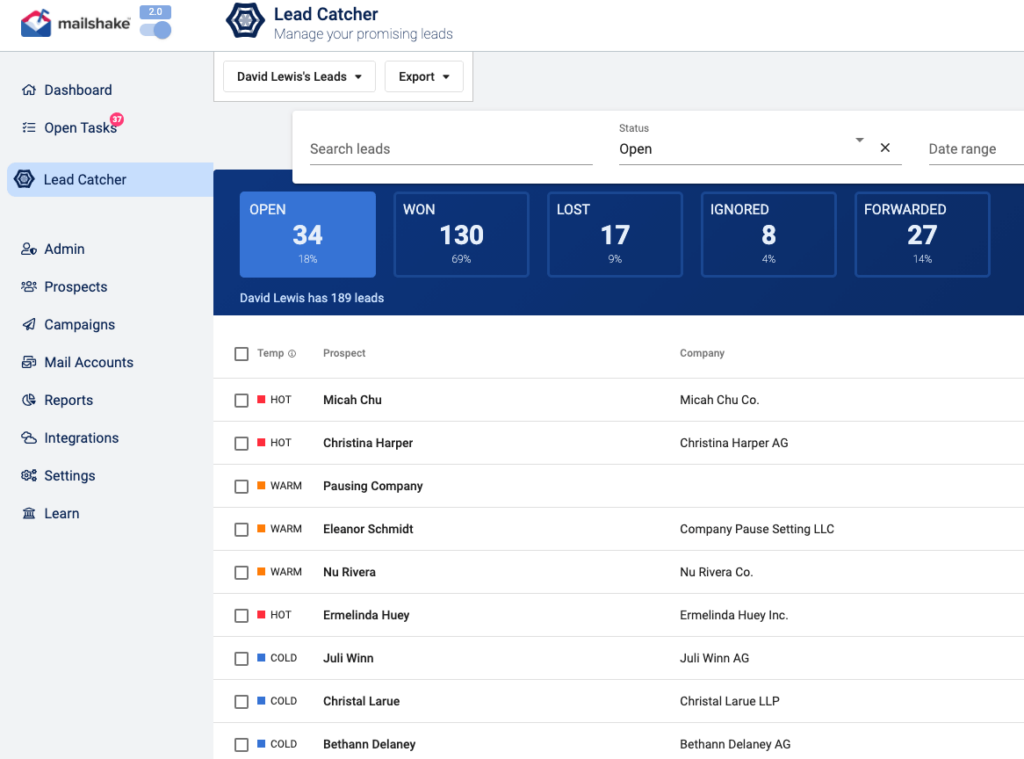
Mailshake is better for straightforward email outreach campaigns where you already have the prospect list and need clean sending, follow-ups, personalization, and reply tracking. It is not a link building database, so you’ll still need Ahrefs, Semrush, Serpzilla, or manual research to qualify prospects first.
But for the sending process, it’s simple and fast. Mailshake supports personalized cold emails at scale, email/phone/social sequences, automated follow-ups, and analytics for opens, replies, and clicks.
So use Mailshake when your list is already segmented by campaign type and quality. For example, one sequence for resource page outreach, one for unlinked mentions, and one for guest contribution pitches.
Ahrefs
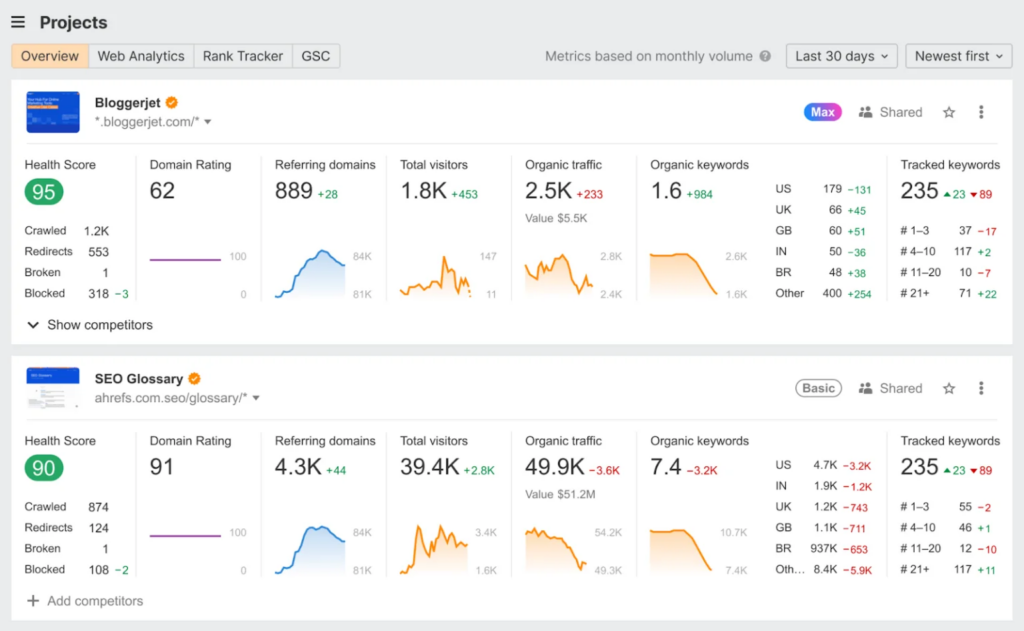
Make the most of comprehensive backlink analysis and competitor research. Its unique selling point is its robust backlink analysis, allowing you to refine your outreach based on data-driven insights.
Ahrefs is not mainly an outreach sender. Rather, it’s where you figure out who is worth pitching and why. Use it to reverse-engineer competitor backlinks, find pages that already link to similar resources, check referring domains, review anchor patterns, and spot linkable content formats in your niche.
Ahrefs’ Site Explorer covers backlink profiles, competitor analysis, backlink spikes, and linked pages, while Content Explorer can help find link prospects and top-performing content across its large page index.
Semrush
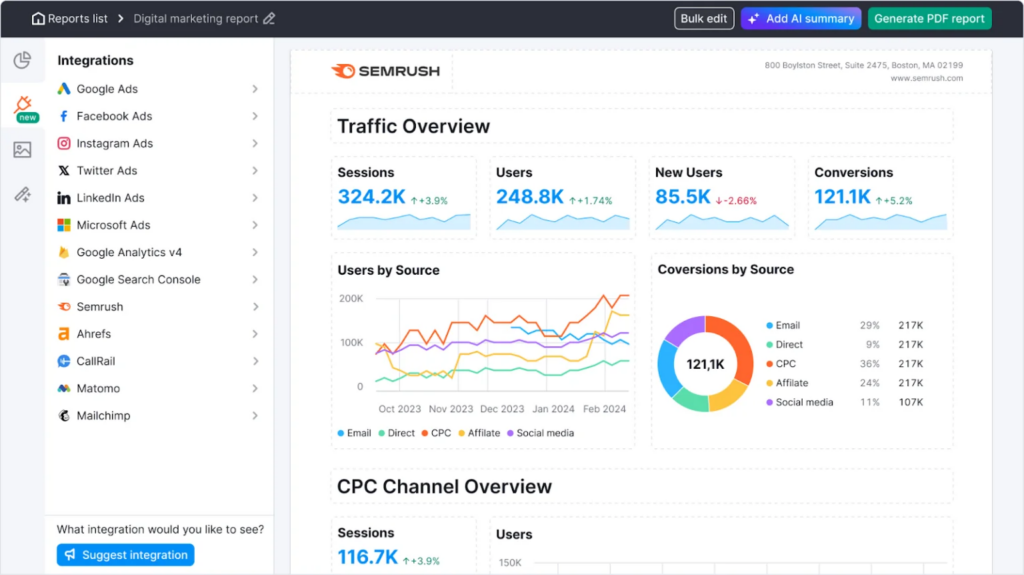
Do you want backlink research, prospect discovery, outreach management, and link monitoring closer together? Use Semrush then. Its Link Building Tool can suggest prospects, let you move domains into outreach, connect email, track replies, and monitor whether links become active, broken, lost, or rejected. Semrush also has backlink audit features for evaluating link quality and identifying risky backlinks.
Buzzstream
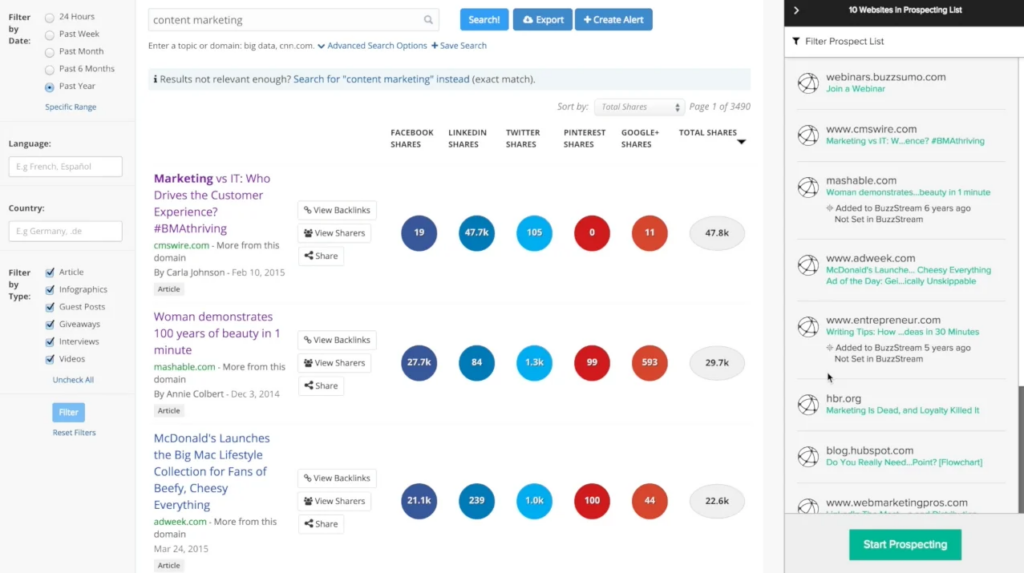
BuzzStream is strong for relationship-based outreach, especially when several people are contacting editors, bloggers, journalists, or site owners over time. It helps with prospect research, contact discovery, outreach organization, email tracking, and relationship history.
The latter is really useful when you don’t want every campaign to feel like a fresh cold pitch. If an editor replied once, rejected one angle, accepted another, or asked you to come back later, that context shouldn’t be lost. For ongoing link building, relationship memory is the difference between a warm second pitch and another generic email in a crowded inbox.
Common Backlink Outreach Mistakes That Might Kill Your Results
Even a solid outreach campaign can fail to deliver if you slip on the basics. Here are the most common issues to watch for:
Contacting the wrong person
A strong pitch won’t help if it lands with someone who doesn’t manage content, partnerships, PR, or editorial decisions. Before sending, check the person’s role and whether they’re actually connected to the page, publication, or campaign type.
Using fake personalization
“I loved your recent article” means nothing if the rest of the email clearly came from a template that wasn’t customized enough. Personalization should prove relevance so be sure to mention:
- the specific page
- topic gap
- audience fit
- reason your asset deserves attention
Pitching weak content
Outreach can’t rescue a thin blog post, generic infographic, or commercial landing page with no clear value. Before asking for a link, make sure the asset gives the recipient something useful:
- original data
- expert insight
- a better explanation
- a tool
- a genuinely helpful resource
Targeting low-quality sites
A backlink is not automatically worth having. Irrelevant sites, obvious link farms, thin guest post blogs, and pages with no real audience can weaken your profile instead of helping it.
Sending too many follow-ups
One polite follow-up is fine. Several can work in some cases. After that, you’re usually creating irritation rather than an opportunity. If there’s no response, move on or rethink the pitch from the ground up.
How to Measure Backlinks Outreach Success
To run outreach as a process, you need to track performance at every stage of the funnel.
Here are the core KPIs:
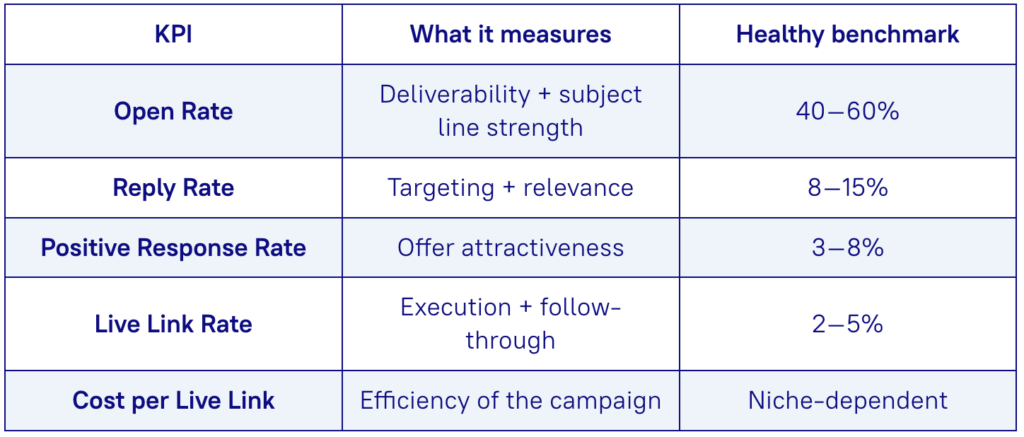
And of course, keep in mind that benchmarks vary, but patterns don’t.
- If open rates are below 35%, fix deliverability or subject lines
- If reply rates are under 5%, your targeting is too broad or your angle is weak
- If positive replies don’t convert into live links, tighten negotiation and follow-ups
Pro tip: For reporting, build a simple table with columns for:
| Prospect | Date Sent | Follow-up | Replied | Positive | Link Live | Anchor | Target URL | Cost |
Review weekly to identify where prospects drop off and optimize that stage.
Conclusion
Link building is not only an important, but also a very time-consuming part of an SEO strategy. To increase your site’s credibility and ranking in search engines, you need to understand the key principles of successful promotion, namely, finding high-quality websites and applying best practices when writing outreach emails.
It’s also important to remember that a personal approach and transparency in communication help build trustworthy relationships with website owners that eventually increase the chances of successful collaboration.
For those looking to simplify the process, Serpzilla offers an efficient solution by making it quick and easy to acquire high-quality guest posts and links on niche-relevant websites.