Why did SEO suddenly get so many new acronyms?
If you feel like SEO woke up one morning and decided to reinvent itself with a handful of new abbreviations, you are not imagining things. Over the past year, search stopped being just a list of blue links. It started answering questions directly, summarizing pages, and stitching information together into neat, confident responses.
As soon as that happened, the industry did what it always does. It named things.
SEO was joined by GEO, AEO, AIEO, and a few other variations that all sound slightly intimidating and slightly redundant. Some people talk about them as if everything we knew before is obsolete. Others insist nothing has really changed.
The truth sits comfortably in the middle. To see why, we first need to agree on what all these terms actually mean.
SEO, AEO, GEO, AIEO: what do these terms actually mean?
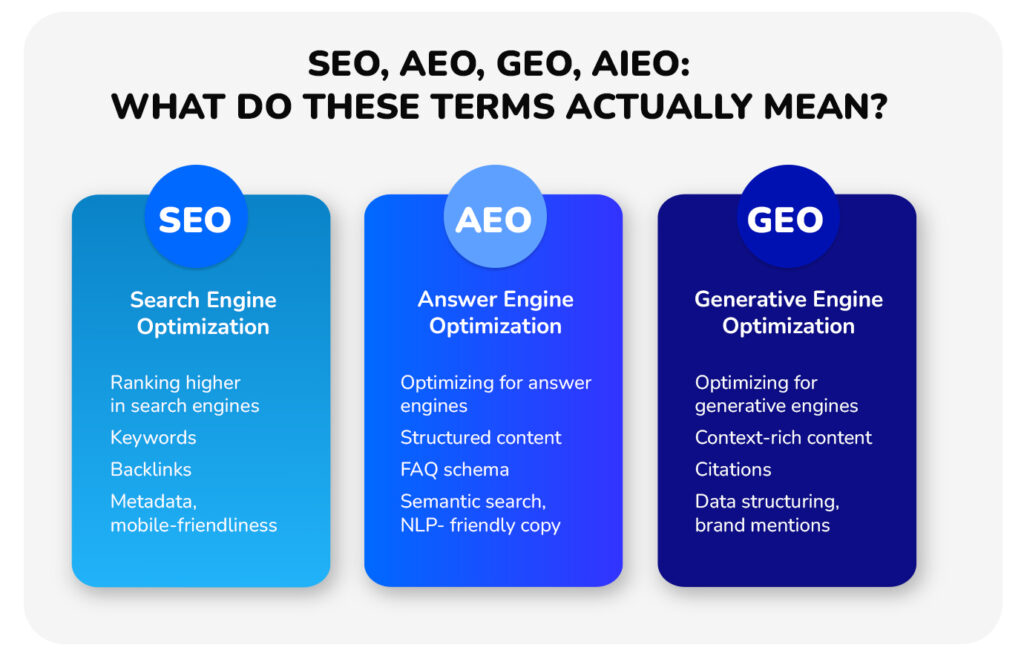
Before we compare them or argue about whether they matter, let’s put clear, boring definitions on the table. No hype, no futurism, just what each term is trying to describe.
SEO (Search Engine Optimization)
This is the foundation everything else sits on. SEO is about optimizing your site so search engines can understand it, trust it, and rank it in organic results. That includes classic rankings, but also things like featured snippets, People Also Ask boxes, and other standard SERP features. If you are doing keyword research, building links, fixing technical issues, or creating content to rank, you are doing SEO.
AEO (Answer Engine Optimization)
AEO focuses on getting your content selected as a direct answer to a question. Think featured snippets, instant answers, People Also Ask, and AI-generated summaries inside search results. The goal here is not always a click. It is visibility and authority at the moment a question is answered. In practice, AEO is SEO with extra attention to structure, clarity, and question-based intent.
GEO (Generative Engine Optimization)
GEO is about being used and referenced by generative AI systems when they produce answers. That includes AI-powered search results and standalone AI tools that summarize information from multiple sources. Instead of ranking positions, the outcome you care about is mentions, citations, and being part of the answer itself. GEO puts more emphasis on entity clarity, topical authority, and content that is easy to extract and summarize.
AIEO (AI Engine Optimization)
AIEO is the vaguest term of the bunch. It usually means “optimizing for AI-driven engines” and is often used as an umbrella for both AEO and GEO. Some people also use it to describe using AI tools to do SEO work, which adds even more confusion. When you see AIEO in the wild, it almost always overlaps with existing SEO and AEO practices.
Other names you may see
You will also run into terms like LLM optimization, AI SEO, or AI search optimization. These are mostly variations on the same theme. Different labels, same core idea: make your content understandable, trustworthy, and useful for systems that generate answers instead of just ranking pages.
Now that we have the definitions out of the way, the differences start to look a lot smaller than the acronym count suggests. Next, we’ll put them side by side and see how they actually compare.
The key differences at a glance
Once you line these terms up next to each other, the fog lifts pretty quickly. They are not competing disciplines. They are different ways of describing where and how your content shows up.
Here is a simplified comparison that reflects how they are actually used in practice.
| Term | Main surface | What “success” looks like | Content bias | Signals that matter most | How you usually measure it |
| SEO | Classic organic results and standard SERP features | Rankings, traffic, conversions | In-depth pages, topic clusters, strong internal linking | Relevance, backlinks, technical quality, brand trust | Rank trackers, Google Search Console, analytics |
| AEO | Answer boxes, Featured Snippets, People Also Ask, AI summaries in SERPs | Being selected as the answer | Clear definitions, step-by-step blocks, FAQs | Clarity, structure, topical authority, trust | SERP feature tracking, visibility in answer boxes |
| GEO | AI-generated answers and summaries | Mentions, citations, inclusion in AI responses | Extractable passages, well-scoped sections, factual clarity | Entity credibility, consistency, authoritative sources | AI visibility tools, manual checks in AI systems |
| AIEO | Mixed AI-driven surfaces | Varies depending on interpretation | Depends on whether it means AEO, GEO, or both | Same signals as SEO, AEO, and GEO combined | Usually a mix of all of the above |
A few things stand out immediately.
First, none of these ignore traditional SEO signals. Even GEO, which sounds the most “new,” still depends heavily on authority, reputation, and relevance. Second, the content formats are not radically different. The same well-structured article can rank, win a snippet, and be summarized by an AI system.
The biggest difference is not what you publish, but how the system consumes it. SEO is about ranking pages. AEO is about answering questions. GEO is about feeding models reliable, well-structured information they can reuse.
Next, let’s look at what actually changes in day-to-day work, and what mostly stays exactly the same.
What really changes in practice (and what doesn’t)
This is the part where expectations usually crash into reality. Despite the shiny new acronyms, your day-to-day SEO work does not suddenly turn into science fiction.
What does change with AEO and GEO
The biggest shift is how content is packaged.
Answer-driven systems care less about poetic introductions and more about getting to the point. Clear definitions, short explanatory blocks, lists, and FAQs suddenly punch above their weight. If a model or a search feature can lift a paragraph and use it as a clean answer, you are doing something right.
Entity clarity also matters more. Brands, people, products, and concepts need to be consistently named and properly explained. This is why About pages, author bios, and unambiguous descriptions play a bigger role than they used to.
There is also more attention on credibility signals that are easy to verify. Referencing reputable sources, aligning with widely accepted terminology, and avoiding vague claims all help AI systems feel more confident about using your content.
What stays almost exactly the same
The foundations of SEO are stubbornly resilient.
Technical health still determines whether your content can be discovered at all. Internal linking still tells systems which pages matter. Topical authority still grows from covering a subject well, not from chasing isolated keywords. And yes, links still matter, because they remain one of the strongest external trust signals available.
If this sounds familiar, that’s because it is. Most “AI optimization” advice boils down to doing solid SEO, then making sure your best content is easier to understand, extract, and trust.
In other words, the strategy did not flip. It got a bit more disciplined. Next, we’ll zoom out and explain why all these approaches overlap so heavily in the first place.
One checklist to rule them all (SEO, AEO, GEO included)
If all this still feels abstract, here’s the practical shortcut. This is a single checklist that works across classic SEO, answer features, and AI-generated results. Do these things well once, and you are covered on most fronts.
- Match one clear intent per page
Pages that try to answer everything usually end up answering nothing particularly well. Clear intent makes ranking, snippet selection, and AI reuse easier. - Put the answer close to the top
A short, direct explanation early on helps search engines and AI systems understand what your page is actually about. - Structure content for extraction
Use headings, lists, tables, and FAQs. If a paragraph can stand on its own as a clear answer, it is far more likely to be reused. - Build topical clusters, not isolated pages
Strong internal linking and coverage depth still signal authority better than any standalone “AI-optimized” page. - Be explicit about entities
Clearly explain who you are, what you do, and how concepts relate to each other. Consistency beats clever wording. - Back claims with references or context
AI systems are cautious by design. Content that shows where facts come from is easier to trust and reuse. - Earn relevant links, not random ones
Authority still compounds. Tools like Serpzilla help here by letting you filter placements by topic, traffic, and quality, so links actually reinforce relevance instead of just inflating metrics. - Track more than rankings
Rankings still matter, but also watch snippets, visibility in answer blocks, and brand mentions in AI tools. That full picture tells you whether your content is being used, not just indexed.
If this checklist looks suspiciously like “good SEO fundamentals plus better structure,” that’s not a coincidence. And that leads directly to the final question: why do all these concepts overlap so much?
Next, we’ll tie it all together and explain why AI-focused optimization mostly builds on traditional SEO rather than replacing it.
Why all of this overlaps so much (and probably always will)
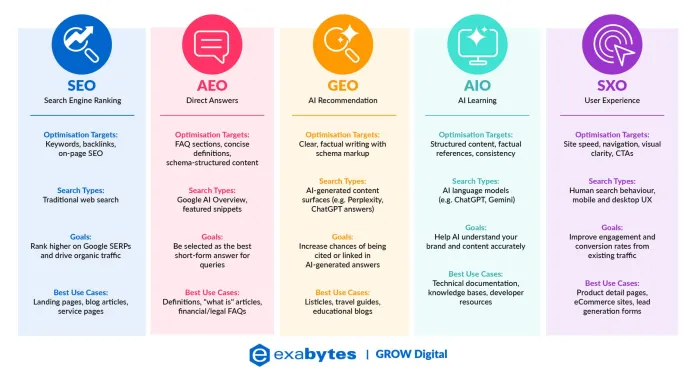
At first glance, SEO, AEO, GEO, and AIEO look like separate disciplines competing for attention. In reality, they are describing the same process from different angles.
Search engines and AI systems are not trying to do fundamentally different things. They all want to understand content, decide whether it is trustworthy, and present it in the most useful format for a given context. The only real difference is how the answer is delivered: a ranked link, a highlighted snippet, or a synthesized response.
That’s why the core signals keep repeating.
Relevance still comes first. If your content does not clearly match an intent or question, no system will pick it. Authority still matters. Whether it is a ranking algorithm or a language model, external validation like links, mentions, and brand consistency remains one of the strongest trust shortcuts available. Clarity still wins. Content that is well-structured and unambiguous is simply easier to reuse.
The newer terms mostly describe distribution layers, not new foundations. AEO zooms in on answer boxes. GEO zooms in on AI-generated responses. AIEO tries to name the whole picture. None of them discard traditional SEO. They sit on top of it.
That is also why “AI-first” strategies often fail when they ignore basics. You cannot optimize for answers if your pages are weak. You cannot expect citations if your site lacks authority. And you cannot shortcut trust with formatting alone.
Final takeaway: which term should you actually use?
If you want a practical rule, keep it simple.
Use SEO as the umbrella. It still describes the full system best.
Use AEO when you are talking specifically about winning answer features inside search results.
Use GEO when the focus is visibility or citations inside AI-generated answers.
Treat AIEO as shorthand, not a new discipline.
If you are already doing solid SEO and structuring your content to answer real questions clearly, you are most of the way there. The acronyms may change. The fundamentals, so far, stubbornly refuse to.
Conclusion
SEO didn’t disappear. It got more surfaces.
What we now call AEO or GEO is mostly a response to where answers show up, not a reinvention of how visibility works. Search engines still rank pages. AI systems still rely on relevance, authority, and clarity. The same well-built content can rank in organic results, win answer boxes, and be reused in AI-generated responses.
If there’s a lesson in all the new terminology, it’s this: strong SEO fundamentals age well. Clear structure, topical depth, and real authority travel across formats far better than chasing the latest acronym. Do that consistently, and whether the answer is a link, a snippet, or a summary, your content has a good chance of being the source.