Are you tired of hearing that AI will replace writers, if not today, then tomorrow? We believe the opposite: it’s here to make writers (or any content creators) dangerously efficient. If you know how to use AI blog writing workflows right, you can produce content faster, keep a consistent publishing schedule, and outrank competitors who rely on outdated processes.
This guide shows you how to write a blog post with AI, from the idea to the finishing touch. You’ll learn how to use AI for blog writing as a system that supports your expertise, SEO skills, and unique voice.
Why Use AI for Blog Post Writing?
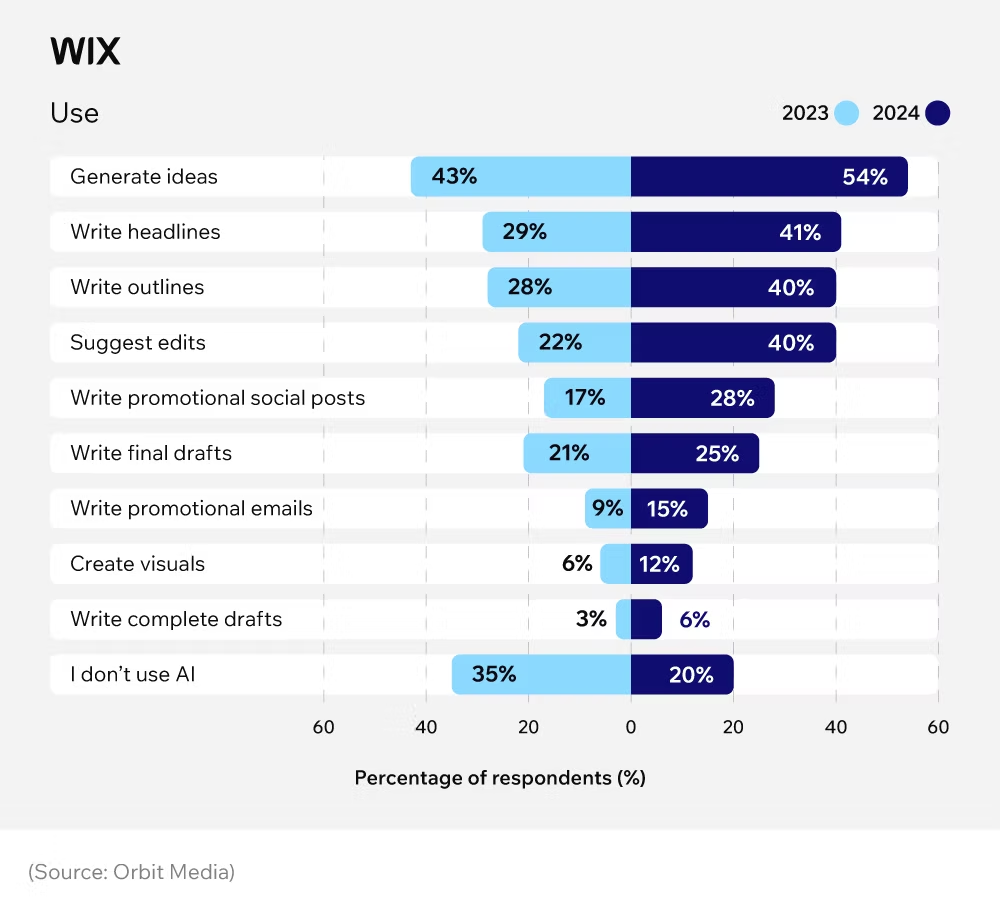
People think AI blog post writing is a two-step process where you enter a short prompt and get a piece ready to go live. That’s not really how high-ranking content works. AI doesn’t replace the writing process, but changes what your time is spent on.
Here’s what that shift looks like when you use AI for writing blog content.
- You eliminate the blank page phase. Lots of writers waste the most time at this stage. AI is the perfect first step: you can ask it to brainstorm angles, cluster keywords, or summarize SERP data before you even draft. On top of that, AI writes blog intros or outlines instantly, so you can take it from there and just refine.
- You get more consistent quality. AI is great at structure, coherence, and keeping your argument tight. When you write blog posts with AI, you build repeatable workflows that improve quality, and you can quickly adjust your approach with a single prompt.
- You scale content output without burning out. Brands that publish steadily win. With blog-writing AI tools, you can generate early drafts, refresh old content, and keep your pipeline full with much less friction, while still controlling the narrative and expertise inside each piece.
- You can focus on human nuance. With an AI draft at hand, your job is to add insights, lived experiences, and the data that will make the piece unique. So you’re no longer technically a writer but more of a curator, strategist, editor, and expert.
- You reduce operational SEO chaos. AI is good at structuring metadata, internal links, FAQ fragments, schema (including markup for AI search), and keyword variations without (or with minimal) human input.
Long story short: the combination of AI blog post writing and your expertise outperforms both humans and AI alone.
Preparing for AI-Assisted Blog Writing
So the rule of thumb is that AI only performs as well as the inputs you give it. The worst blog-written-by-AI examples come from people skipping the prep phase entirely. Let’s set the foundation so that your results will be solid and require only a little refinement before publishing.
Pinpoint your goal and target audience
If you want to tank AI-assisted content, give it a vague objective. The thing is, AI is excellent at executing tasks, but only when the task is clearly given to it.
Before you prompt anything, get brutally specific about the mission of your piece. You’re solving a search problem and a business problem at the same time, remember?
Clarify:
- Who you’re writing for (their knowledge level, role, and specific pain point)
- Why this article needs to exist (what gap you’re filling on the SERP)
- What search intent you’re targeting (informational, comparative, transactional)
- What the reader should walk away with (a framework, a solution, a plan)
- What the business outcome is (rankings, signups, authority, user education)
When AI gets all this input, it pivots from generic content to generating content that’s directionally accurate and aligned with real SEO outcomes.
Collect brief and key inputs for AI
As you might already know, high‑quality AI blog post writing starts with a structured brief. Feed your tool as many details as you can, including:
- Keywords
- SERP or competitor URLs
- Required sections
- Tone preferences
- Brand/product context
- Internal link priorities
- What competitors got wrong
- What you know that they don’t
A complete brief provides the signals AI uses to shape relevance, coverage, and depth. Don’t underestimate this preparatory prompting process.
AI Content Generation Workflows
To start producing AI-written blog posts, try this realistic, field-tested workflow used by content teams who rely on AI daily.
Step 1. Generate topic titles
71% of content marketers use AI for content ideation.
Source: Humanizeai.com
Of course, you can simply ask AI to give you 5-10 titles based on a wider theme, but let’s make it a bit more focused and results-driven for your SEO efforts.
A better approach is to start by defining the angle that will stand out on your topic SERP. Ask AI to:
- Scan the SERP (paste snippets or URLs)
- Suggest titles that match intent
- Add 2–3 contrarian or advanced angles
With real URLs in front of it, the algorithm sees what type of content is popular, the clichés they can’t let go of, and the gaps nobody bothers to fill. Besides, AI starts shaping titles around what the searcher clearly wants in that moment. This will help it dig for tension points, missed perspectives, and deeper takes.
Example prompt:
“Based on these 5 URLs, suggest 15 titles for a long-form guide targeting ‘AI blog writing’. Focus on intermediate/advanced readers who are bored with basic AI advice. Make titles specific, avoid empty clickbait.”
Step 2. Use AI to build a detailed outline
A solid outline prevents the classic smooth‑but‑empty AI-written blog problem. This is also where you can take early control over where the algorithm wants the content to go and suggest quick tweaks.
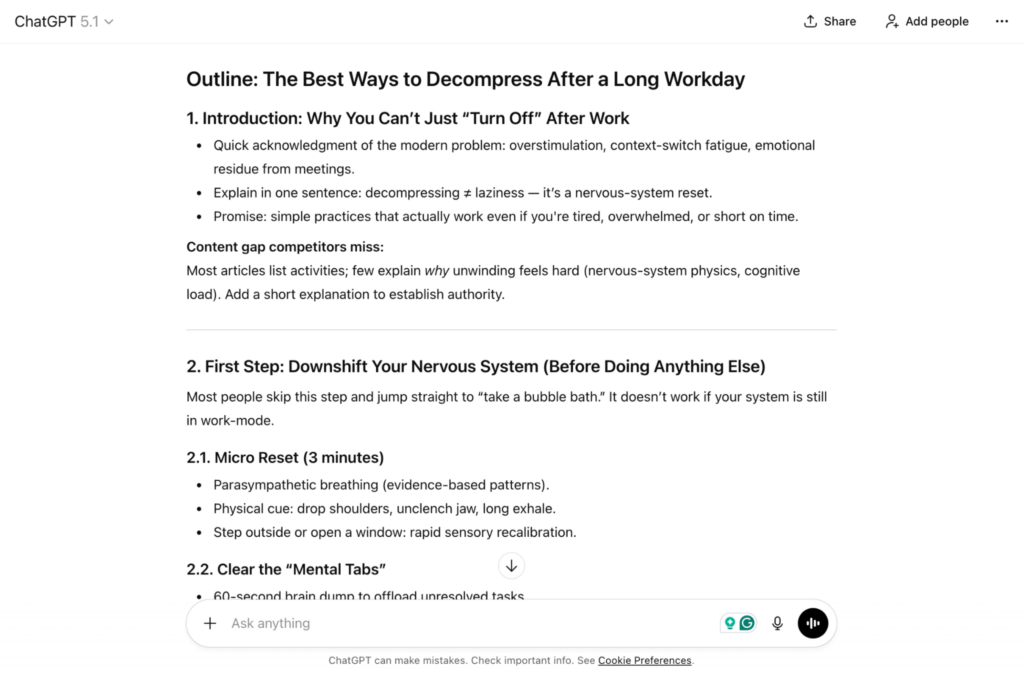
The best strategy here is to build a hybrid outline with:
- Required SEO subtopics
- Missing gaps the competitors ignored
- Unique insights you bring to the table
- Structural constraints (word counts, format, CTAs)
- Internal links with anchors
Example prompt:
“Combine these SERP subtopics [insert subtopics] + my expertise points [insert points] into a detailed outline with word counts. Include content gaps competitors missed. Tone: [insert tone directions, e.g., direct, expert, conversational]. Ensure the structure supports search intent [insert intent].”
Step 3. Draft sections of the post with AI
This is probably the most misunderstood step in AI blog writing, because people are often tempted to just tell AI to “write this article.” Sure, you already have an outline and some good SEO directions, but AI should never write the full article in one go.
Instead, break it into sections, feed the model your outline, and give it constraints for each.
Example prompt:
“Write Section [insert section title from the outline]. Follow my outline exactly. Include: [key points]. Add examples. Avoid filler. Use short sentences with zero clichés. Maintain my tone: [insert ToV]. Keep keyword: [insert keyword] natural.”
Getting the article generated in sections also allows you to check the text in smaller chunks and catch any inconsistencies and mistakes early.
Step 4. Add your expertise
How do you turn AI blog post writing into something Google really respects? You enrich it with your unique perspective, advice, or critique. You can add a variety of specifics to the text to make it more valuable, including:
- Know-hows and frameworks
- Screenshots
- Internal processes
- Original insights
- Real mistakes you’ve made or experiences you’ve had
- Data from your experience
- Emotional nuance
Once again, you can use AI to help you out here. Feed it your raw insights and then ask it to refine or structure them in a way that will fit the existing draft.
Example prompt:
“Here’s my raw opinion/insight [insert]. Rewrite it into a clean, structured expert commentary without losing my tone of voice.”
Step 5. Optimize the blog post for SEO
Our goal is to rank on Google, so this step is a must. Here, remember that modern optimization is about completeness, clarity, and relevance. Don’t waste your time on simply jamming keywords into the text. Make AI your SEO assistant and ask it to:
- Extract all keywords used
- Suggest missing subtopics
- Rewrite headers for clarity
- Improve internal linking
- Generate meta title + meta description
- Simplify long sentences
- Propose schema markup
- Run a readability check
Example prompt:
“Act as an SEO editor. Analyze this article and list missing semantically important topics, duplicated ideas, weak transitions, and unclear sections. Suggest metadata and schema markup. Then show me a revised version.”
Step 6. Do the final review, fact check, and formatting
This step is another non-negotiable, mainly because AI can sometimes make stuff up. Your job is to make sure that the content is on point and free of errors.
As you go through the article text, do the following:
- Validate stats (ask AI to give you the link to the source material and check if the link is real and live)
- Verify claims
- Correct outdated info
- Ensure that all examples make sense
- Remove filler and repetitive ideas
- Make the tone human by giving the draft small tweaks where you see fit
Formatting matters too, so check if the headings are logical and the CTA placement is appropriate. You can also enrich the draft with infographics and illustrations, expert quotes, and/or accent blocks.
Using AI to Improve Existing Blog Content
Updating existing articles is one of the highest-ROI moves in SEO. The hard part is already done: the URL is indexed, the page has history, and Google has context. A few targeted improvements can move a post faster than publishing something new.
Google loves fresh stuff, and your older posts might be full of:
- Outdated stats
- Missing subtopics
- Messy structure
- Broken internal links
- Weak intros and thin conclusions
- Opportunities for new visuals
- Irrelevant references
That’s exactly what you can quickly target and fix with the help of AI. Let’s see how.
Ask AI to audit the content for SEO gaps
Most older articles are simply misaligned with today’s SERP, and we know that Google evolves fast with intent shifts and competitors adding new angles. An AI audit shows you where the cracks are, like missing subtopics, repeated ideas, outdated terminology, and sections that no longer satisfy what searchers expect. Let AI cross-compare your post with the top result patterns and produce a gap list instantly.
The algorithm gives you a blunt snapshot of what no longer works and what competitors are winning with. You’ll end up with:
- Subtopics to add
- Explanations to simplify
- Fluff to remove
- Intent mismatches to fix
Example prompt:
“Here’s my article and SERP snippets from the current top results. Audit them side-by-side. Identify missing subtopics, intent gaps, outdated examples, redundant sections, and anything competitors consistently cover that I don’t. Then give me a prioritized list of fixes with estimated impact. Article: [paste]. SERP: [paste].”
Strengthen internal linking
Internal linking is one of the most overlooked ranking levers in older articles that were published before the rest of your content ecosystem existed. They often sit isolated, even though they could be distributing authority across newer pages or receiving contextual support from related topics.
AI can scan your entire URL list, understand topical relationships, and propose strategic links that reinforce your site architecture.
Example prompt:
“Here is my article and a list of all URLs on my site. Spot where internal links should be added to strengthen topic clusters, improve relevance, and direct authority to key pages. Recommend specific anchor text for each link and rank the opportunities by impact. Article: [paste]. URL list: [paste].”
Pro tip: Once you’ve strengthened your internal links, improve the updated article’s authority by pointing a few high-quality external backlinks to it. Use Serpzilla to buy targeted placements on domains already ranking in your niche. The combo works extremely well: internal links distribute the authority across your cluster, and Serpzilla’s backlinks give the refreshed article an immediate external trust boost. This is one of the fastest ways to revive older URLs that lost positions over time.
Refresh stats, examples, and references
Outdated stats are the fastest way to signal to Google (and readers) that your content is stale. A 2019 study sitting in a 2025 article instantly reduces trust. AI helps you locate every stat, reference, and time-sensitive claim, then rewrite the surrounding text after you supply newer data. The same goes for examples that age quickly as products evolve and user behavior changes.
Example prompt:
“Review this article and highlight all outdated stats, years, product references, and time-sensitive examples. For each one, rewrite the surrounding sentences so they can accept the updated data I’ll provide next. Then list where new stats or modern examples are needed. Article: [paste].”
How to Avoid AI Detection
Let’s be clear on this one before going forward: Google doesn’t punish AI writing. What it punishes is low-quality, generic, unoriginal content. If you use the strategies listed above, chances are you’re already producing text that reads like a human expert shaped it. Besides, most of the existing AI tools are pretty unreliable.
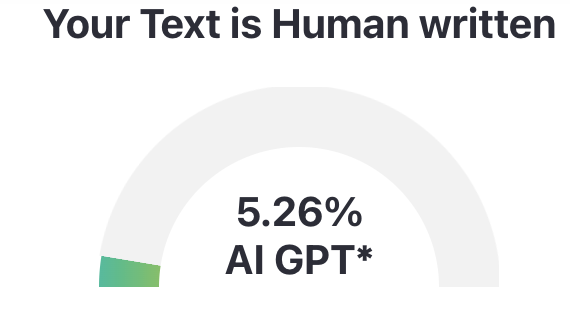
Yet, if you need to pass an obligatory AI checker for your AI-written blog article, make sure to:
- Inject personal experience. AI detectors fail on original insights.
- Use short, varied sentence structures. AI loves symmetry, so your task is to break it.
- Add sensory details and specific context. These are things AI doesn’t naturally produce.
- Rewrite intros and conclusions manually. These are the most predictable parts.
- Use AI for structure, not for voice. The voice must come from you.
Bottom line: An AI-written blog is detectable only if it sounds like something anyone could generate. Make it uniquely yours, and the problem disappears.
Checklist: Using AI to Write Better SEO Blog Posts
Use this as your pre-publish workflow for AI writing blog posts. If you checked all the boxes, you’re 100% good to go.
- Goal and audience defined
- SERP researched and pasted into prompts
- Outline built with AI + your expertise
- Sections generated individually, not in one go
- Expert layer added manually
- Examples, frameworks, metaphors included
- SEO edits done
- Keywords integrated naturally
- Voice and tone clearly human
- Facts checked and updated
- Article formatted for readability
- CTA placed strategically
- Schema and metadata generated
- Internal links added
- Final human read-through done
If you follow this checklist every time you write blog posts with AI, your output becomes predictable, consistent, and rankings-ready.
FAQ
Can Google detect AI-written content?
Not really. Besides, Google doesn’t care how content is produced, only whether it’s helpful, accurate, original, and aligned with search intent. AI is allowed, but low-quality AI is not.
Will AI replace human blog writers?
No. It replaces manual labor and repetitive processes, not human expertise and judgment. Writers who know how to use AI to write blog posts will replace writers who don’t.
How do I keep my unique voice when using AI?
Inject your experience, rewrite key paragraphs manually, and give AI strong, detailed tone instructions. Think of AI as a co-writer, not the author of your piece.
How often should I update AI-generated posts?
Every 6–12 months, or sooner if the SERP shifts. Use AI for blog writing to refresh structure and clarity, but update stats yourself.