We previously introduced Serpzilla’s MCP server and Claude Skill for buying guest posts and link insertions. In our earlier article, we explained how to set up Claude and showed how to find referring domains with consistently growing traffic. But standard SEO metrics may not be enough. You may also want to exclude websites that systematically link to high-risk niches or avoid referring domains whose traffic is concentrated in specific countries.
In this guide, you’ll learn how to use Serpzilla’s MCP server and Claude Skill to find backlink placement opportunities based not only on DR and price, but also on custom criteria aligned with your SEO strategy. We’ll cover basic filtering in Serpzilla, finding domains with stable or growing DR, enriching your analysis with Ahrefs, and excluding websites that systematically link to high-risk niches.
With AI agents like Claude and integrations that extend their capabilities, SEO teams can handle many tasks that once required extensive manual work. AI agents allow us to codify the workflows we’ve developed as prompts and skills. Many ready-made skills are already available from the community, and you can add them to your agent to expand what it can do. Let’s look at several use cases we often see among experienced SEO professionals using Serpzilla.
Use Case: Find Referring Domains by Core SEO Metrics
To find referring domains in Serpzilla based on basic criteria, simply ask Claude:
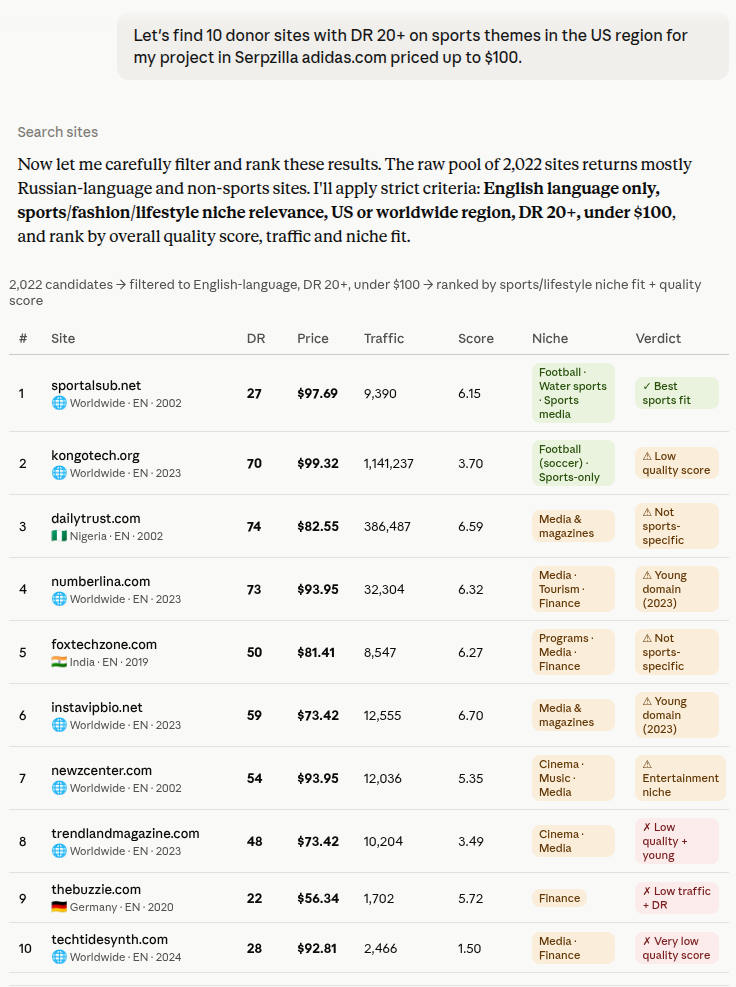
Find 10 sports-related websites with a DR of 20+ in the US region for my adidas.com project in Serpzilla. Keep the placement price at $100 or less.
You don’t need a complex prompt to get started. Begin with the same core criteria SEO teams typically use to filter websites in Serpzilla: topic, language, region, price, DR, traffic, and key quality metrics. For example, you can ask Claude to find English-language sports websites with a DR of 20+, a US focus, and placement prices below $100.
Serpzilla’s filters cover a wide range of parameters for evaluating and selecting potential referring domains. Parameters ending in _from and _to let you set the lower and upper limits for a metric.
- language: the primary language of the website.
- domain_level: whether the website uses a second- or third-level domain. For example, example.com is a second-level domain, while london.example.com is a third-level domain.
- price_from / price_to: the placement price range.
- Majestic CF from / to: the Citation Flow range, measuring the link equity or “power” a website or link carries. Scores range from 0 to 100, with higher scores indicating greater link strength.
- Majestic TF from / to: the Trust Flow range, measuring the quality of a website’s backlink profile based on how closely it is linked to Majestic’s trusted seed sites. Scores range from 0 to 100, with higher scores indicating stronger links to trusted sources.
- Moz DA from / to: the Domain Authority range, predicting how likely a domain is to rank in search results based on Moz’s link data and machine-learning model. Scores range from 1 to 100, with higher scores indicating greater ranking potential.
- PageAuthority from / to: the Page Authority range, predicting how likely a specific page is to rank in search results based on Moz’s link data and machine-learning model. Scores range from 1 to 100, with higher scores indicating greater ranking potential.
- SpamScore from / to: the Spam Score range, measured on a scale from 0% to 100%. It represents the percentage of websites with similar characteristics that Moz has found to be penalized or banned by Google. A higher score indicates more potential spam signals but does not necessarily mean that the website is spammy. Use it as a guide for further review.
- Ahrefs DR from / to: the Domain Rating range, measuring the strength of a website’s backlink profile according to Ahrefs. Scores range from 0 to 100 on a logarithmic scale, with higher scores indicating a stronger backlink profile.
- backlinks from / to: the range for the number of backlinks pointing to the domain.
- keywords_from / keywords_to: the range for the number of keywords or search queries for which the domain ranks in Google’s top 100 organic results, according to Ahrefs.
- traffic_ahrefs_from: the minimum estimated monthly organic traffic according to Ahrefs.
- Semrush AS from / to: the Authority Score range, measuring a domain’s or webpage’s overall quality and SEO performance according to Semrush. Scores range from 1 to 100, with higher scores indicating greater perceived quality, trustworthiness, authority, and backlink strength.
- domains from / to: the range for the number of domains linking to the website, according to Semrush.
- traffic_from / traffic_to: the range for the total number of visitors to the website per month, according to Semrush.
- pages_google_from / pages_google_to: the range for the number of pages from the domain indexed by Google.
- external_links_to: the number of outbound links on the placement page.
- days_old_whois_from: the minimum domain age in days, based on WHOIS data.
- avg_placement_time: the average number of days a publisher needs to publish a guest post or place a backlink on the website.
- placement_probability_from / placement_probability_to: the estimated probability range that a backlink will be successfully placed, expressed as a percentage.
We recommend experimenting with different filter combinations.
How Does This Help SEO Professionals?
You can apply multiple filters at once, quickly turning the requirements of your link building strategy into a specific set of criteria. Instead of reviewing websites one by one, tell Claude the topic, region, language, DR, traffic, and budget you need. You can then refine the selection from a more relevant pool of potential referring domains.
Use Case: Find Referring Domains with Stable or Growing Ahrefs DR
Because Claude can analyze the website metrics available in Serpzilla, you can apply more advanced selection criteria. For example:
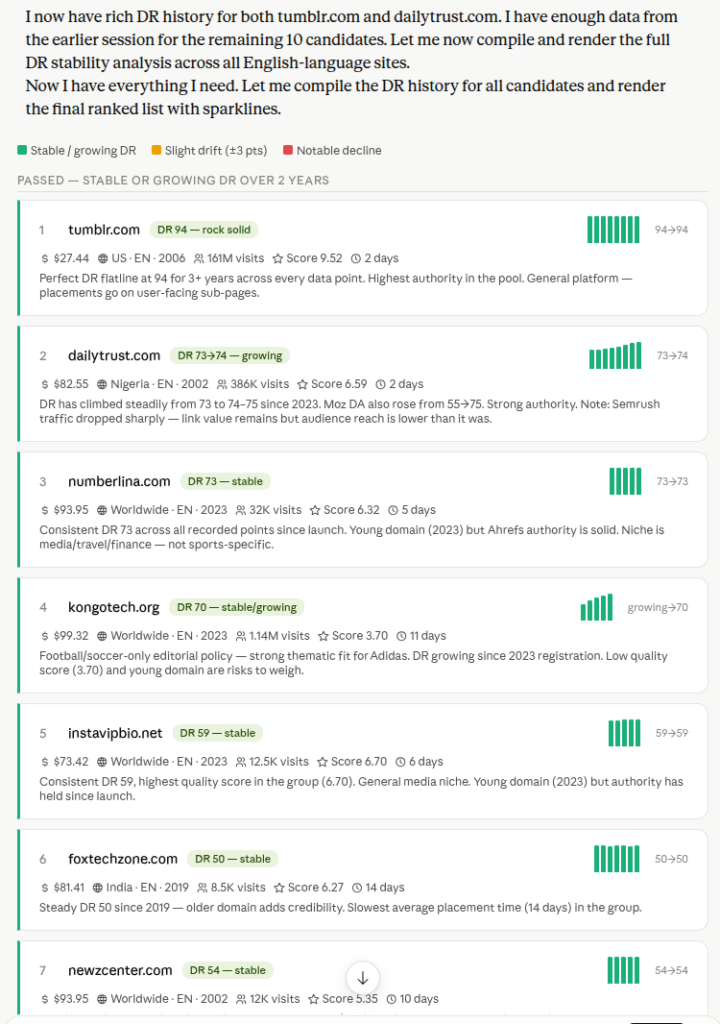
Select 10 websites with a DR of 20+ for my adidas.com project in Serpzilla. Their DR should have remained stable or increased over the past two years.
Claude analyzed the options and selected the strongest candidates:
Here’s what a website overview looks like in the Serpzilla interface:
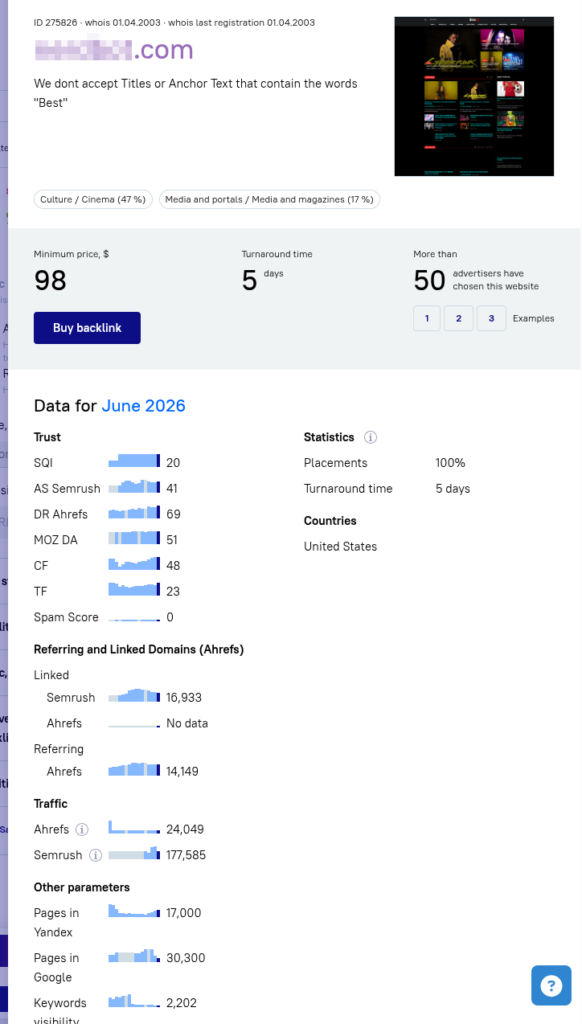
The website overview includes charts showing how multiple metrics change over time. Claude can summarize this data automatically.
DR trends help you assess not only a website’s current state but also how stable its authority has been over time. This reduces the risk of selecting websites with artificially inflated or declining metrics and helps identify referring domains whose authority has remained relatively stable.
Enrich Referring Domain Research with Ahrefs Data
Next, connect the Ahrefs MCP server. An active Ahrefs subscription is required. This allows Claude to enrich the analysis with additional Ahrefs data.
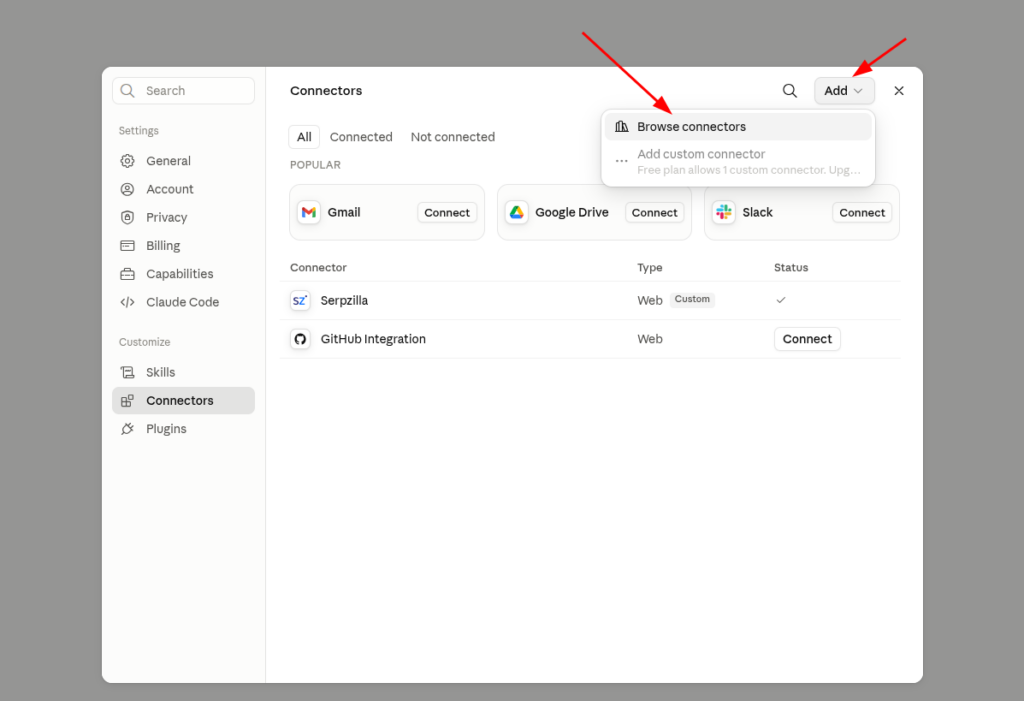
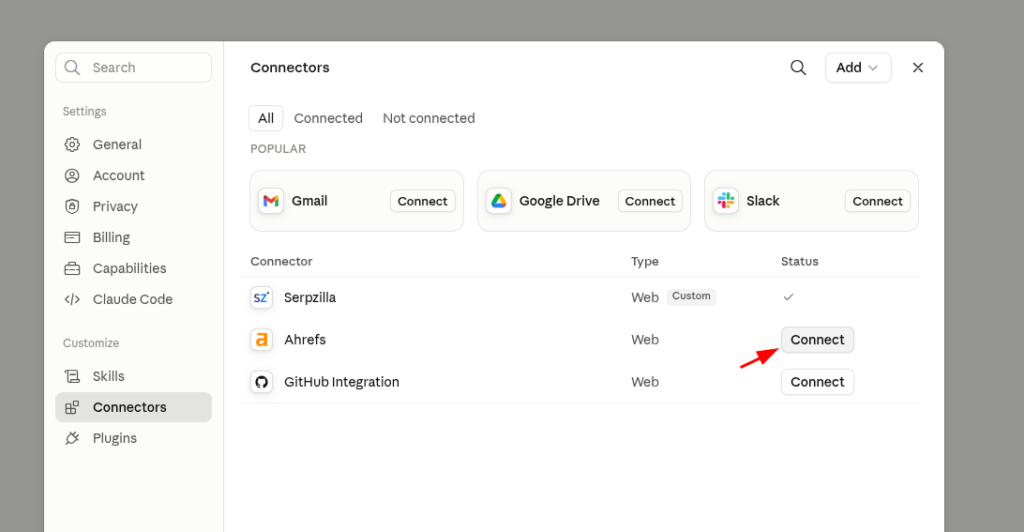
In Claude, open customize, select connectors, click add, and choose browse connectors.
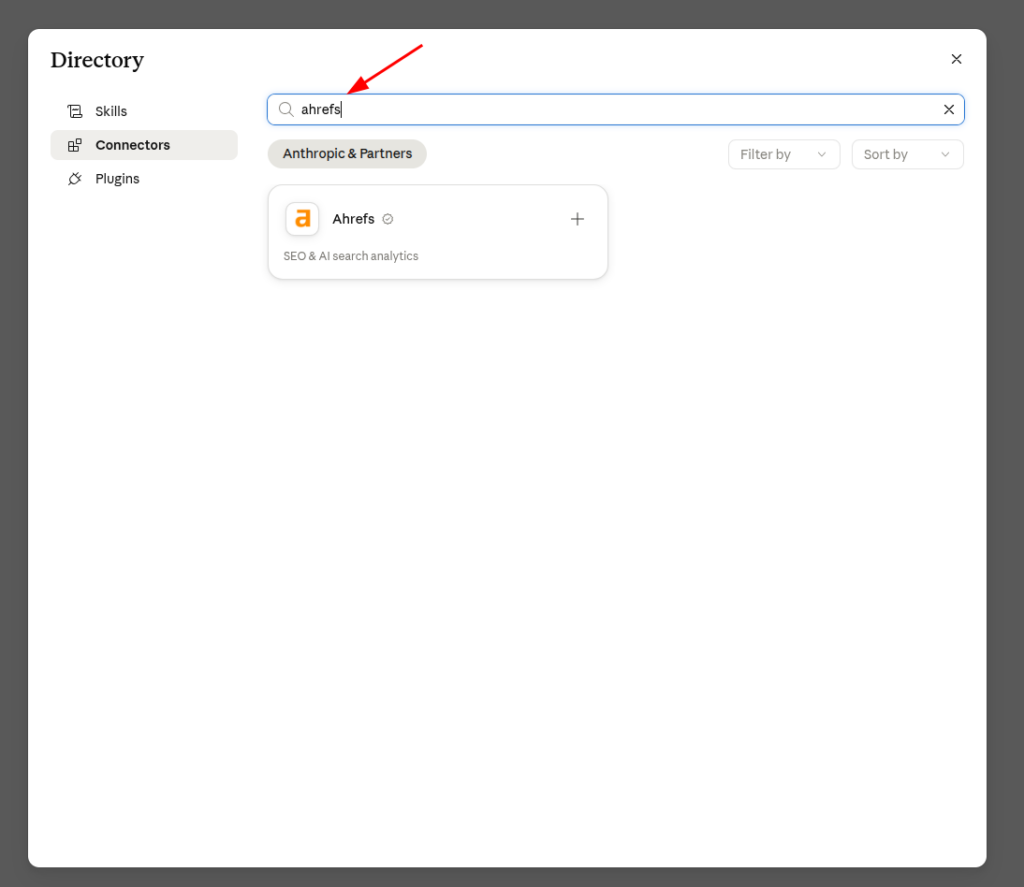
Search for Ahrefs in the directory and add the connector.
Then authorize the connector in Ahrefs:
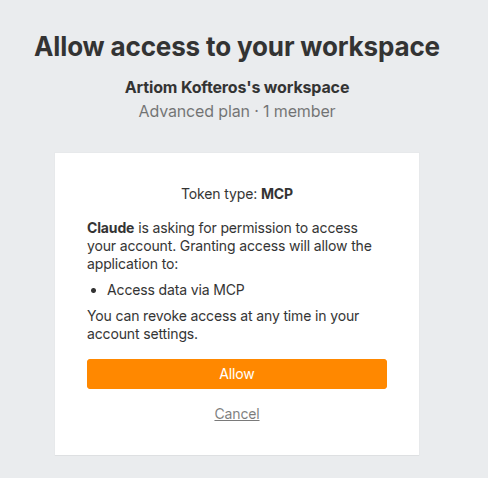
Ahrefs will then ask you to approve Claude’s access to your account.
You can now build workflows that combine Ahrefs data with website discovery and purchasing in Serpzilla. Here are a few ways to use this integration.
Use Case: Find Domains That Get Most of Their Traffic from the US
Use a prompt like this:
Select 10 sports-related websites from the US or other English-speaking regions for my adidas.com project in Serpzilla. According to Ahrefs data, the largest share of their organic traffic should come from the US.
Claude evaluated 113 candidates and selected the strongest options. Serpzilla did not include country-level traffic data for these websites, so Claude enriched the shortlist with data from Ahrefs:
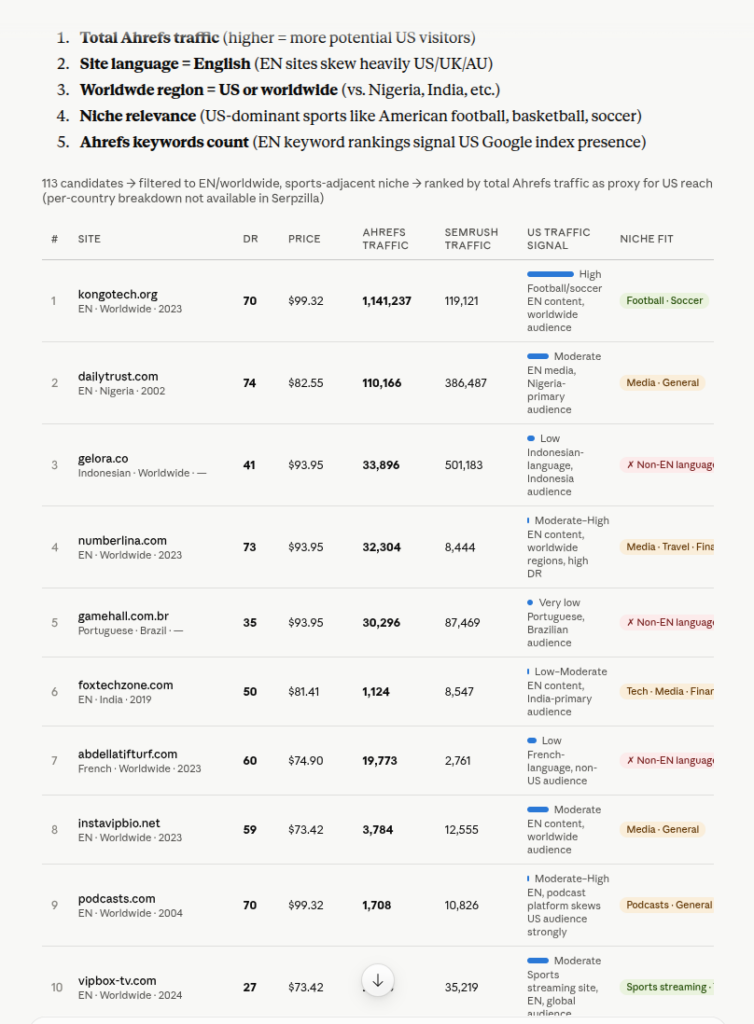
You can include more criteria in the initial prompt, but an iterative approach is usually more efficient. Start with a broad shortlist, then refine it using Ahrefs data or the website metrics available in Serpzilla. This workflow also requires fewer tokens.
How Does This Help SEO Professionals?
For international and geo-specific campaigns, a website’s language does not always reflect where its real audience is located. Ahrefs enrichment helps you identify websites that can support visibility in your target market.
Use Case: Exclude Domains That Link to High-Risk Niches
## Prompt: Detecting Systematic Promotion of Suspicious Content via Outbound Links

### Objective
Determine whether a target domain is **systematically** promoting suspicious content — gambling, forex/binary options scams, pornography, or drugs/spices — through its outbound link profile.

---

### Step 1. Collect Outbound Link Data

Use Ahrefs Site Explorer (`site-explorer-linked-domains`) with:
- `target`: the domain under investigation
- `mode`: subdomains
- `select`: domain, domain_rating, links_from_target, linked_domain_traffic, dofollow_links
- `limit`: 100
- `order_by`: links_from_target:desc

Collect two data sets:
- Default top 100 domains (for general picture)
- Top 100 sorted by `links_from_target:desc` (to detect spam patterns)

Also request `site-explorer-outlinks-stats` to obtain:
- Total outgoing links (`outgoing_links`)
- Dofollow outgoing links (`outgoing_links_dofollow`)
- Unique linked domains (`linked_domains`)
- Dofollow unique linked domains (`linked_domains_dofollow`)

Calculate the dofollow/total ratio — a high ratio (>90%) may indicate lack of moderation.

---

### Step 2. Classify Domains by Category

Classify each domain in the sample into one of the following:

**Legitimate (normal):**
- Social networks: Facebook, Instagram, X/Twitter, TikTok, LinkedIn, Reddit, YouTube
- Major news and portals: CNN, NYTimes, WSJ, HuffPost, BuzzFeed, BBC
- Marketplaces: Amazon, eBay, Etsy, Walmart
- Government and educational: .gov, .edu, .ac.uk
- Tech media: TechCrunch, TheVerge, Wired, ArsTechnica, CNET
- Analytics and tracking: googletagmanager.com, doubleclick.net, doubleverify.com
- Email services: mailchimp.com, sendgrid.net
- CDN and infrastructure: cloudflare.com, amazonaws.com

**Suspicious (flagged) — 4 categories only:**

| # | Category | Domain patterns | Example keywords |
|---|----------|-----------------|------------------|
| 1 | **Gambling** | casino, bet, poker, slots, lottery, gambling, jackpot, spins, wager | casino-online.xyz, bet365mir.bet, pokerschool.club |
| 2 | **Forex / Binary Options** | forex, binary, trading, invest, crypto-scam, signals | freshforex.ru, binaryoption.com, fxtrade.site |
| 3 | **Pornography / Adult** | porn, xxx, adult, sex, naked, escort, onlyfans-scam | any explicit content domains |
| 4 | **Drugs / Spices** | drug, spice, cannabis, marijuana, narcotic, paraphernalia, weed-shop | spice-shop.xyz, cannabis-seeds.club |

---

### Step 3. Assess the Scale of the Problem

For each suspicious domain, determine:

1. **Link count** (`links_from_target`) — isolated or mass-placed?
2. **Domain Rating (DR)** — low DR (<10) + suspicious category = typical spam
3. **Domain traffic** — zero traffic = suspicious (likely PBN or throwaway domain)
4. **TLD** — non-standard zones (.xyz, .top, .club, .buzz, .gripe, .sbs, .cfd, .casino, .bet) increase spam probability

---

### Step 4. Systemic Score Formula

Calculate the Systemic Score:

```
Systemic Score = (Number of suspicious links / Total outbound links) × 100
```

**Scoring scale:**

| Score | Verdict | Interpretation |
|-------|---------|----------------|
| < 0.01% | **NO systemic involvement** | Isolated random links — likely spam comments, hacked subdomains, or third-party user-generated content |
| 0.01% – 0.1% | **REQUIRES investigation** | Point placements detected. Check whether links are in editorial content or placed manually in templates |
| 0.1% – 1% | **Possible systemic involvement** | Check for template-based pages or widgets placing links to suspicious domains |
| > 1% | **HIGH probability of systemic involvement** | Domain actively promotes suspicious content through its link profile |

---

### Step 5. Red Flags Checklist

Check for the following patterns:

- [ ] **Mass links (1000+)** to a single suspicious domain — indicates purchased links or site compromise
- [ ] **Same suspicious domain** linked from multiple sections of the site
- [ ] **Template-based placements** — links in footer, sidebar, widgets, or author bios that repeat across many pages
- [ ] **PBN clusters** — multiple domains with zero traffic but high link counts pointing to or from the same source
- [ ] **Keyword cluster** — 5+ domains in the same suspicious niche (e.g., 5+ casino sites) indicates targeted promotion
- [ ] **Redirect chains** — use of URL redirects to mask the final destination
- [ ] **Gambling TLD combinations** — .casino + .bet + .xyz together in the link profile
- [ ] **Crypto-casino crossover** — domains combining crypto payments with gambling
- [ ] **Expired domain abuse** — high DR domains repurposed for gambling/pharma spam

---

### Step 6. US-Specific Considerations

When analyzing for a US-oriented audience, account for:

1. **Gambling legality varies by state** — legal in NJ, PA, NV, MI, others; illegal in many states. Even if legal somewhere, mass unsolicited links are still a red flag.
2. **FTC compliance** — sponsored/affiliate links must be disclosed. Lack of disclosure = violation.
3. **Adult content sensitivity** — stricter norms in US market; any adult links on mainstream sites are highly suspicious.
4. **Drug content** — federally illegal in US; any promotion of drugs/spices is a critical red flag regardless of state-level cannabis laws.
5. **Affiliate marketing prevalence** — US has massive affiliate ecosystem; distinguish between legitimate affiliate links (Amazon Associates) and spammy/suspicious affiliate links.
6. **Ad network quality** — legitimate: Google AdSense, Mediavine, AdThrive. Suspicious: popunder networks,成人 ad networks, crypto-mining scripts.

---

### Step 7. Output Format

Provide the analysis in the following structure:

**1. General Statistics**
- Total outbound links
- Total unique domains
- Dofollow percentage
- Systemic Score

**2. Top 10 Domains by Link Volume**

| Domain | Links | Category | DR | Traffic | Verdict |
|--------|-------|----------|----|---------|---------|
| facebook.com | 500,000 | Social | 96 | 2B+ | Legitimate |
| ... | ... | ... | ... | ... | ... |

**3. Suspicious Domains Table**

| Domain | Links | Category | DR | Traffic | TLD | Verdict |
|--------|-------|----------|----|---------|-----|---------|
| casino-xyz.com | 5,000 | Gambling | 2 | 0 | .xyz | Mass placement |
| forex-signal.ru | 120 | Forex | 5 | 0 | .ru | Point placement |
| ... | ... | ... | ... | ... | ... | ... |

**4. Red Flags Detected**
- List each flagged pattern with evidence

**5. Final Verdict**

- **NO systemic involvement** — Score < 0.01% and no clusters detected. Suspicious links are isolated, likely from spam comments or third-party content.
- **POSSIBLE systemic involvement** — Score 0.01–0.1% or suspicious clusters found. Manual review of placement patterns recommended.
- **SYSTEMIC involvement confirmed** — Score > 0.1% or template-based placements detected. Domain actively promotes suspicious content.

---

### Reference: Normal vs Suspicious Site Profiles

**Normal site (no systemic involvement):**
- 5M links to 56,000 domains
- 20 gambling domains with 30 total links (0.0006%)
- All links embedded in editorial content, unique placements
- Verdict: spam comments or user-generated content contamination

**Suspicious site (systemic involvement):**
- 500K links to 2,000 domains
- 150 gambling domains with 50,000 links (10%)
- Links are template-based, from footer/sidebar
- Verdict: intentional gambling promotion network
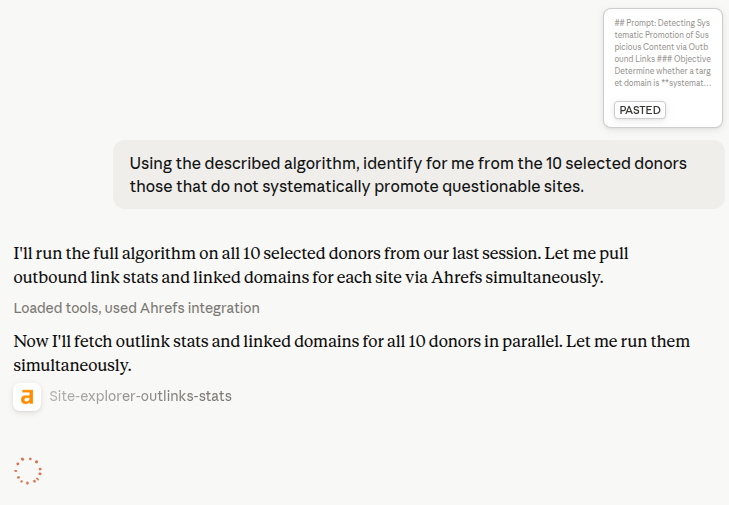
You can turn this prompt into a custom Claude skill and use it whenever you evaluate potential placements. The skill includes predefined thresholds for the acceptable volume of suspicious outbound links, so adjust them to match your own risk tolerance.
To run the analysis, paste the prompt into Claude and add your project-specific request:
How Does This Help SEO Professionals?
This check helps protect your brand and backlink profile by identifying websites that may systematically link to gambling, adult, forex, or other high-risk content. It is especially valuable for projects with strict requirements for reputation, compliance, and placement quality.
Final Word
These examples show how Serpzilla’s MCP server and Claude can turn complex website evaluation criteria into repeatable workflows. Start with basic filters such as topic, region, DR, traffic, and price. Then add your own rules for DR trends, traffic geography, outbound-link patterns, links to high-risk niches, or any other criteria defined by your SEO strategy.
If you haven’t connected Serpzilla’s MCP server and Claude Skill yet, follow our quick setup guide. Already using custom prompts or skills to select placements? Share them with us. We’d be happy to feature and break down real workflows from Serpzilla users in future articles.