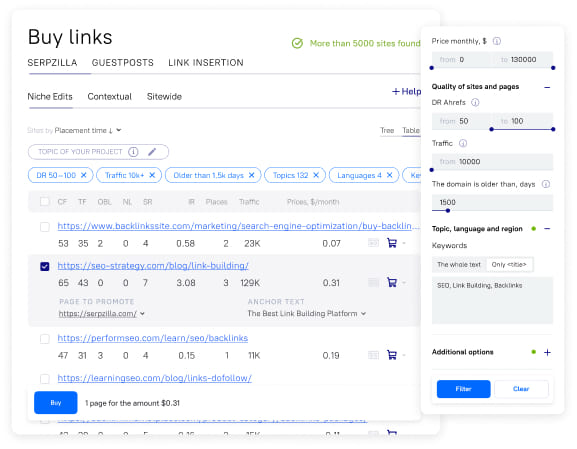
Imagine: a DeFi protocol lands a link from a respected DeFi news site, propelling them up search results and sparking valuable partnerships. Or, a blockchain educational platform secures backlinks from universities, establishing their content as authoritative and attracting students. Link building, done right, is the best way to achieve success in the crypto and blockchain world.
Link building is vital for all crypto and blockchain projects.
- It builds trust and legitimacy – high-quality backlinks act like endorsements, vital in a space rife with skepticism.
- It boosts search engine rankings, driving organic traffic and eyeballs to your project.
- It fosters community and collaboration – guest posts and resource exchanges create meaningful connections within the ecosystem.
What Is Crypto Link Building
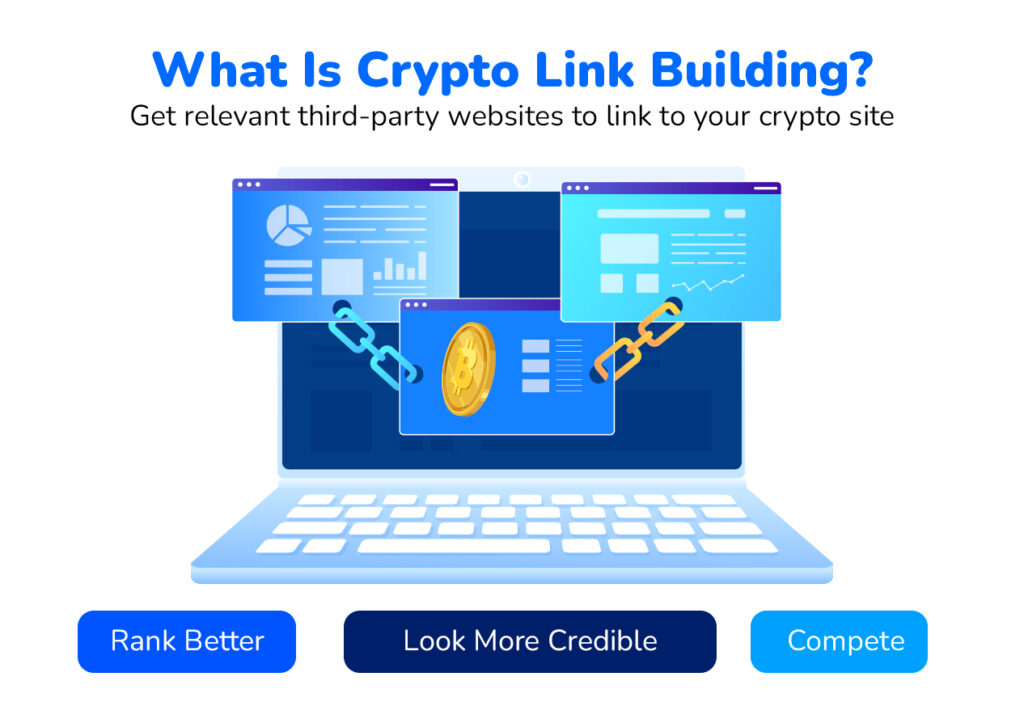
Crypto link building is the process of getting relevant third-party websites to link to your crypto site so it can rank better, look more credible, and compete in a niche where trust is always under pressure.
Differences between crypto link building and traditional link building
In crypto, link building is tougher than in most niches because the space sits much closer to YMYL territory: your content can influence financial decisions, so the bar for trust is higher (and Google applies a higher trust standard to topics that affect people’s financial stability).
On top of that, many publishers are cautious about linking to crypto projects at all, while the niche itself is flooded with weak affiliate sites, recycled content, and outright spam. This makes donor selection far more sensitive. A bad link here can make the brand look riskier, less credible, and too dependent on manufactured authority.
Let’s look into the differences from traditional link building in more detail:
| Aspect | Crypto Link Building | Traditional Link Building |
| Content Focus | Emphasis on blockchain, crypto trends, and technological innovations. | Typically revolves around diverse topics relevant to specific industries. |
| Niche Relevance | Prioritizes links from crypto-related platforms to enhance niche authority. | Seeks links from industry-specific sites outside the crypto sector. |
| Community Engagement | Actively involves participation in crypto communities and forums. | Engagement with forums and communities related to specific business sectors. |
| Trust Factors | Strong emphasis on building trust through crypto community endorsements. | Trust building may rely on established industry partnerships and endorsements. |
| Dynamic Trends | Rapid adaptation to evolving crypto trends and emerging technologies. | Adapts to industry-specific trends and market dynamics. |
| Link Placement Criteria | Values contextual placement within crypto-focused content. | Focuses on relevant placement within content related to specific industries. |
| Risk Consideration | Addresses unique risks associated with crypto market volatility and regulatory changes. | Generally considers industry-specific risks without the same level of regulatory volatility. |
| Authority Sources | Collaboration with reputable crypto influencers and platforms. | Collaboration with industry influencers and established platforms. |
| SEO Algorithm Considerations | Adapts to the intricacies of crypto-related search algorithms. | Aligns with general SEO algorithms with a focus on industry-specific nuances. |
Why Is Link Building Important for Cryptocurrency Sites?

Source: https://cdn.21shares.com/.
The scale of the crypto industry is hard to ignore: by late 2025, crypto ETPs alone were approaching $300 billion in assets under management, with cumulative net inflows nearing $100 billion.
At the same time, crypto is a brutally competitive space full of trust problems. You are not just trying to outrank other websites. You are also trying to prove your project deserves to be taken seriously in a market flooded with copycat content, aggressive affiliates, and sketchy promises.
That’s exactly why backlinks are a big factor here. Strong links from relevant crypto, finance, tech, and cybersecurity sites help search engines see your website as credible, and they help users do the same.
In crypto, visibility without trust does not convert well. And trust without outside validation rarely scales in search. Good link building helps a ton. It gives your site stronger rankings, stronger positioning, and stronger proof that your brand exists beyond its own hype.
Sergei Pankov
8 Best Link Building Strategies for Crypto Websites
Take a close look at the most solid ways to build crypto links for your website and specific campaigns.
Creating high-quality content
Crafting high-quality content is foundational to successful link building for crypto sites. Focus on generating engaging, informative, and shareable content that resonates with your target audience. Explore trending topics in the cryptocurrency space, offer unique insights, and ensure your content provides real value. Employing a variety of media, such as articles, videos, and guides, can enhance the appeal of your content for both users and potential linking sites.
Guest posting
Engaging in guest posting is a strategic approach to securing backlinks from relevant and authoritative sites in the crypto niche. Identify platforms that align with your content and industry focus. Develop personalized outreach strategies to establish connections with editors and site owners. Share your expertise through well-crafted guest posts, emphasizing the value your content brings to their audience.
Using social media and online communities
Use social media platforms, such as Reddit and Twitter, along with crypto-specific forums. Actively participate in discussions, share your content, and build relationships with influencers in the cryptocurrency space. By fostering genuine connections, you increase the likelihood of your content being shared and linked within these influential circles.
Working with broken links
Identifying broken links on relevant sites presents an opportunity to replace them with your cryptocurrency content. Conduct thorough research to pinpoint broken links within your niche. Reach out to site owners with a solution — your high-quality content — as a replacement. This approach not only aids in link acquisition but also helps webmasters maintain a healthy and updated site.
Infographics
Leveraging the visual appeal and shareability of infographics can be a powerful link-building strategy. Create visually appealing infographics that effectively communicate your project’s values, operating principles, or unique features. Share these infographics across platforms and encourage others to use them, fostering organic link generation as users embed them in their content.
Unlinked brand mentions
The unlinked brand mentions strategy involves identifying instances where your brand is mentioned but not linked. Reach out to the content creators or website owners to kindly request the inclusion of a hyperlink. This method capitalizes on existing brand recognition and increases the likelihood of converting mentions into valuable backlinks.
Link exchange
Explore the A-B-C exchange strategy, where Site A links to Site B, Site B links to Site C, and Site C links back to Site A. While this can be effective, it requires careful consideration of the relevancy and authority of each site involved. Examples include industry collaborations, partnerships, or thematic connections. Understand the nuances of link exchange, ensuring a balanced and mutually beneficial approach.
Crypto affiliate programs
Implementing cryptocurrency affiliate programs can significantly boost online visibility and brand memorability. Develop and promote affiliate programs that incentivize partners to share and link to your content. This creates a network of affiliates actively contributing to the growth of your link profile while mutually benefiting from the collaboration.
By strategically implementing these diverse link-building approaches, crypto sites can enhance their online presence, authority, and engagement within the dynamic landscape of the cryptocurrency industry.
Crypto Link Building Common Mistakes
Crypto link building goes wrong fast when teams chase volume, force relevance, or treat a high-risk niche like any other SEO vertical. Here are a few specific pitfalls you should avoid at all costs.
1. Focusing solely on quantity
One common mistake is prioritizing the sheer quantity of backlinks rather than their quality. To rectify this, emphasize acquiring links from reputable and relevant sources within the crypto community. Quality links from authoritative websites can contribute more significantly to your project’s credibility and search engine rankings.
2. Ignoring the relevance of link sources
Choosing irrelevant link sources can harm your project’s reputation. Address this by conducting thorough research to ensure links come from sources directly related to the crypto industry. Aligning with reputable crypto websites enhances the value and relevance of your backlinks.
3. Overusing exact-match anchor text
Over-reliance on exact-match anchor text can lead to penalties from search engines. Resolve this by diversifying anchor text with variations that include brand names, generic terms, and relevant phrases. This SEO strategy maintains a natural link profile and helps avoid algorithmic penalties.
4. Neglecting internal linking
Neglecting internal linking hinders the distribution of link equity across your website. Correct this by strategically incorporating internal links within your content, guiding users to relevant pages. This not only strengthens your site’s architecture but also improves user experience and SEO.
5. Overlooking broken link building
Overlooking broken link building as an opportunity is a mistake. Identify broken links on reputable crypto websites, and reach out to suggest your relevant content as a replacement. This proactive approach can lead to valuable link acquisitions.
6. Not diversifying link building strategies
Relying on a single link building strategy exposes your project to risks. Diversify your approach by combining methods such as guest posting, influencer collaborations, and social media promotion. This safeguards your link profile and ensures resilience against changes in search algorithms.
7. Failing to monitor and remove toxic links
Failure to monitor and remove toxic links can harm your project’s credibility. Regularly audit your backlink profile using tools like Google Search Console and disavow toxic links. This proactive stance helps maintain a healthy link portfolio.
8. Ignoring the value of competitor analysis
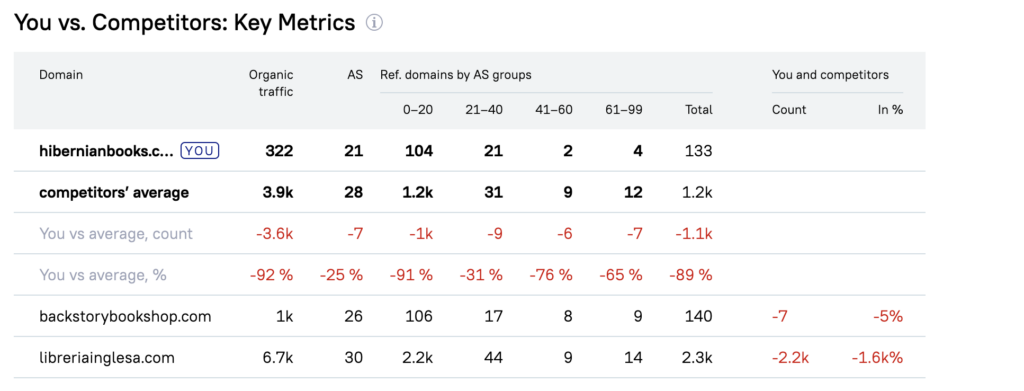
Neglecting competitor analysis means missing out on valuable insights. Analyze your competitors’ link-building strategies to identify opportunities and gaps. Incorporate these findings into your approach, leveraging successful tactics and avoiding potential pitfalls.
Pro tip: Use Serpzilla’s Backlink Gap Analyzer to see where competitors are performing better, spot which authority tiers or link segments you are missing, and turn this gap into a clearer acquisition plan.
How Does Link Building Differ by Crypto Website Type?
Crypto link building works best when the strategy matches the product’s trust model. A user choosing an exchange, evaluating a wallet, or researching a DeFi protocol is not looking for the same proof points. That is why the strongest link profiles in this space are usually built around the right type of authority for that specific website.
Sergei Pankov
Link building for crypto exchanges
Crypto exchanges need links that strengthen trust, authority, and commercial visibility. Since users compare platforms before signing up, link building should support pages tied to fees, supported assets, security, regional availability, and exchange comparisons.
The strongest strategies here are digital PR, comparison list placements, expert commentary, and links from finance, trading, and crypto media. Review-style mentions and “best crypto exchanges” roundups can also be effective, but only when the placement is credible and relevant.
Link building for crypto wallets
Wallets depend heavily on security perception and product understanding. People want to know whether the wallet is safe, easy to use, compatible with certain chains, and suitable for specific use cases (like staking, DeFi access, or NFT storage).
That makes educational linkable assets especially effective:
- Setup guides
- Wallet comparisons
- Security explainers
- Seed phrase protection content
- Ecosystem-specific tutorials
Outreach should target crypto education sites, cybersecurity publications, wallet comparison posts, and blockchain communities.
Link building for DeFi platforms
DeFi platforms need links that build topical relevance and protocol legitimacy in a high-risk environment.
The best-fit strategies include thought leadership, data-backed content, ecosystem partnerships, protocol explainers, and contributions to industry discussions. You can talk about staking, liquidity, yield strategies, governance, or risk management. Remember: DeFi link building works best when it earns contextual links from highly relevant crypto and fintech sources.
Link building for blockchain SaaS and Web3 tools
Blockchain SaaS products and Web3 tools usually target a more technical or B2B audience, so link building should focus on product discoverability, use-case credibility, and problem-solving content. These sites benefit less from hype-driven coverage and more from links that explain what the tool does and why teams should trust it.
The most effective strategies include:
- Integration pages
- Technical tutorials
- API documentation support
- Founder or expert contributions
- Case studies
- List placements in “best tools” or “top platforms” articles
How Does Crypto Link Building Differ by Market?
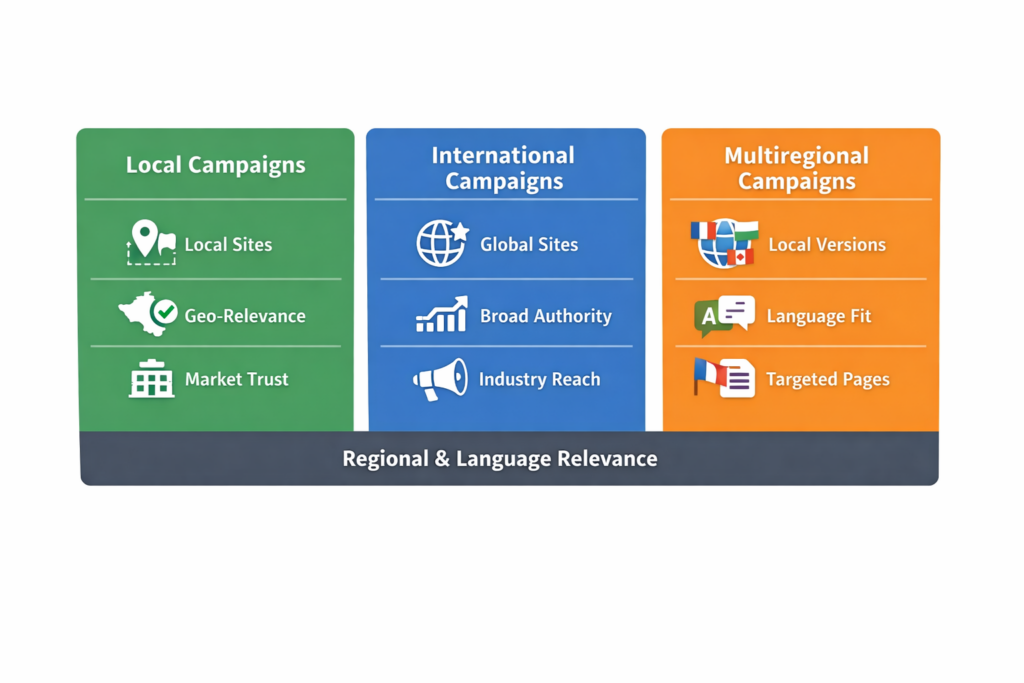
Crypto link building is not just shaped by website type. It also changes depending on where the campaign needs to rank. A local campaign, a global English-language push, and a multiregional strategy all need different link sources, different landing pages, and different relevance signals.
Link building for local crypto campaigns
Local crypto campaigns need links that reinforce geographic relevance and market trust. This usually applies to:
- Exchanges, wallets, or crypto services targeting users in a specific country or city through local landing pages
- Regional offers
- Location-specific compliance messaging
The best links here come from country-level finance media, local business publications, regional crypto blogs, startup ecosystems, and niche directories that actually matter in that market. Links should support localized pages, not just the main domain.
Link building for international crypto campaigns
International campaigns usually aim to build visibility across broad, high-competition markets without tailoring heavily to each country. In that case, the goal is to earn links that strengthen global authority and broad topical relevance.
Placements on reputable crypto media, finance publications, SaaS roundups, industry blogs, and thought leadership platforms are the best pick here. The focus is less on local trust signals and more on building a strong authority layer that helps the domain compete across multiple markets.
Link building for multiregional and multilingual crypto campaigns
Multiregional campaigns are more complex because they need both central authority and market-specific trust signals. If a crypto brand has separate pages or subfolders for different countries or languages, the link building strategy should support those versions directly.
That means earning links from relevant publishers in each priority market, using language-matched outreach, and building links to localized commercial and educational pages. A German page should earn German-language links, while a LATAM campaign should build visibility in Spanish-language or Portuguese-language ecosystems where appropriate.
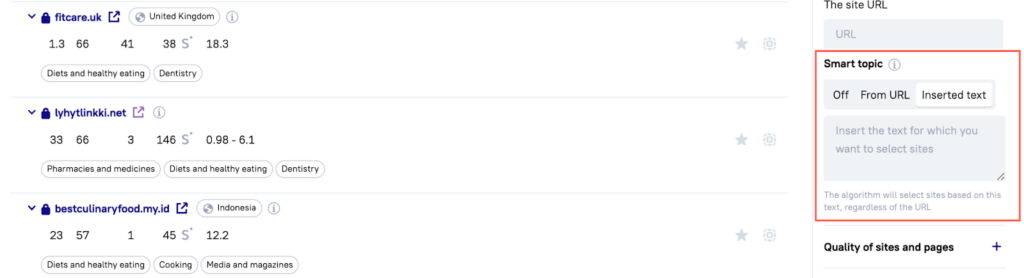
Pro tip: Find relevant local placements in Serpzilla for your geo-specific crypto link building campaigns. Filter donors by country, language, and traffic source, and use Smart Topic to match placements to your exact market context instead of relying on generic “crypto” categories.
Which Criteria Define a High-Quality Crypto Backlink Opportunity?
When you think of what makes a backlink trustworthy, you should look at the big picture. The real question is whether the link comes from a site that looks credible, relevant, and editorially real in a niche where weak placements are everywhere. Let’s look at the most important signals.
Niche and topical relevance
A crypto backlink should come from a site that makes sense for the topic. This doesn’t always mean another pure-play crypto website, but it should be close enough in context to feel natural (for example, fintech, investing, cybersecurity, payments, or blockchain infrastructure).
Domain trust and organic strength
Strong backlink opportunities usually come from domains that show signs of real trust like:
- Solid authority metrics
- Stable organic traffic
- A clean-looking search presence
DR or DA can help with first-pass filtering, but they should never be used alone. A site with decent authority and real traffic is usually more valuable than a stronger-looking domain propped up by weak pages and thin visibility.
Editorial placement and context
Where the link appears matters almost as much as where it comes from. The best crypto backlinks are placed inside relevant editorial content, surrounded by context that supports the mention. A link hidden in a weak guest post, author box, or filler paragraph simply isn’t as valuable.
Low spam risk
Crypto is full of sites that look acceptable on the surface and terrible on closer inspection. That’s why spam screening is non-negotiable. If a domain is overloaded with casino, CBD, adult, payday loan, or random affiliate content, it is a bad sign. The same goes for obvious link-selling footprints, erratic content quality, and pages built only to host outbound links.
How to Build a Crypto Link Building Campaign Step by Step
Here’s a simple, easily repeatable flow for an effective crypto link building campaign with Serpzilla.
1. Research and identify target websites
To create links from cryptocurrency-related websites, start by conducting thorough research to identify target websites within the crypto niche. Look for reputable and authoritative platforms that align with your project’s goals. Consider factors such as domain authority, relevance, and community engagement. Building links from established sites can enhance your project’s credibility and visibility within the cryptocurrency community.
2. Look into the niche in depth
A deep understanding of the cryptocurrency niche is key for effective link building. Stay informed about the latest trends, news, and discussions within the crypto space. This knowledge will enable you to create content that resonates with the target audience and establishes your project as a valuable contributor to the community. Being well-versed in the niche also helps in identifying the most influential websites for link-building opportunities.
3. Create content that is valuable and relevant
Crafting content that provides genuine value to the cryptocurrency community is crucial. Develop informative articles, guides, or multimedia content that addresses specific issues, educates, or entertains the audience. Ensure that your content is not only relevant but also adds something new or unique to the existing conversation. Valuable content is more likely to be shared and linked to by other websites in the crypto space.
4. Define your link strategy
Establish a clear and well-defined link-building strategy tailored to your project’s objectives. Determine whether you’ll focus on guest posting, resource link building, or collaboration with influencers. Having a strategy in place ensures a systematic approach to acquiring links and helps in measuring the effectiveness of your efforts.
5. Determine your link budget
Allocate resources for your link-building efforts by defining a budget. This may include expenses for content creation, outreach tools, or collaborations. A well-planned budget ensures that you can execute your link-building strategy effectively and make the most of available resources.
6. Create linkable content
“Linkable” content is not just well-written, it also gives other sites a reason to reference it. In crypto, that usually means original data, clear comparisons, or practical utility.
Focus on formats that naturally attract links:
- Research and data breakdowns (e.g., exchange fees, wallet adoption, DeFi yields)
- Side-by-side comparisons (wallets, chains, platforms)
- Step-by-step guides that solve real user problems
- Explainers for complex topics (staking, bridges, tokenomics)
The key is to build assets that publishers can cite, not just read. If your content does not add anything new (data, clarity, or perspective) it will be very hard to place links without forcing them.
7. Build a donor list
Start by pulling prospects from competitor backlinks, SERP leaders, and relevant media in crypto, fintech, and adjacent niches. Then filter aggressively:
- Topical fit (not just “crypto”, look at actual content)
- Organic traffic and stability
- Link placement style (editorial vs. obvious paid slots)
- Outbound link quality (who else they link to)
In Serpzilla, you can speed this up by filtering donors by topic, geo, traffic, and placement type, then narrowing down to sites that match your exact campaign goals.
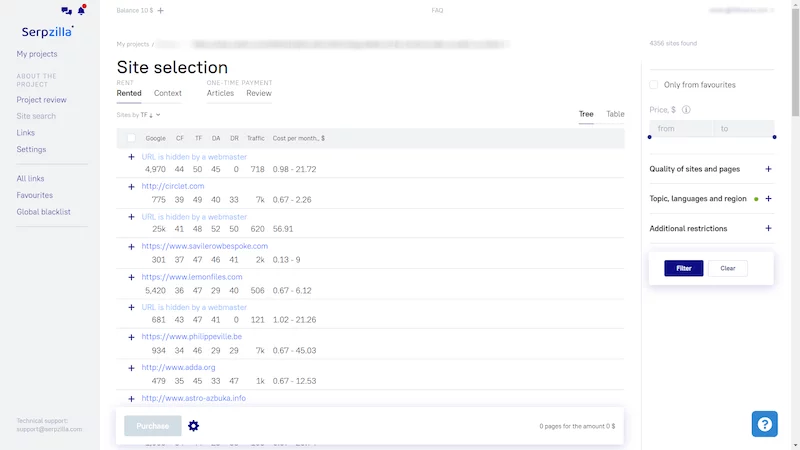
The outcome should not be a huge list but a focused set of donors that you’d actually trust linking to your brand.
You can also use Serpzilla for launching guest posts, niche edits, and other types of contextual placements that fit naturally into existing content and support your link profile without leaving obvious footprints.
8. Diversify anchors
A healthy anchor mix should include:
- Branded anchors (your project name)
- URL anchors
- Partial-match and long-tail variations
- Neutral anchors (“learn more,” “this guide,” etc.)
The goal is to mirror how real websites link — inconsistently, contextually, and without forcing keywords.
Don’t skip this step, although it looks less “big-picture” than others. Aggressive anchor patterns are one of the fastest ways to make a backlink profile look artificial.
Sergei Pankov
9. Create a 6-12 month promotion plan
Craft a comprehensive promotion plan outlining the activities and milestones for the next 6-12 months. This plan should cover content release schedules, outreach efforts, and targeted campaigns. A long-term approach allows for sustained link-building efforts and helps build enduring relationships within the cryptocurrency community.
10. Regularly monitor the backlinks you receive
Consistently monitor the backlinks your project receives to assess their quality and relevance. Utilize tools like Google Search Console or third-party backlink analysis tools to track new links and identify any potentially harmful ones. Regular monitoring enables you to address issues promptly, ensuring a healthy and effective link profile over time.
Key Metrics to Measure Crypto Link Building Performance
Successfully implementing a link building strategy is not just about acquiring links but also about assessing the impact on your website’s performance and visibility. Here are key metrics to track:
Referral traffic
This is one of the primary indicators of successful link building is an increase in referral traffic. Monitor the traffic coming to your site from the links you’ve built. A rise in referral traffic suggests that your links are not only present but also driving users to explore your content.
Search engine rankings
Keep a close eye on your search engine rankings, especially for targeted keywords. Improved rankings indicate that search engines recognize the relevance and authority of your site, often influenced by the quality and quantity of your backlinks.
Domain Authority (DA) and Page Authority (PA)
Regularly check changes in your domain authority and page authority. An increase in these metrics signifies that your link building efforts are positively impacting the overall authority and credibility of your website. Tools like Moz or Ahrefs can help in tracking these scores.
Conversion rates
Assess how well your link building efforts are translating into conversions. Whether it’s sign-ups, purchases, or other desired actions, a successful link building strategy should contribute to an improvement in conversion rates. This indicates that the traffic generated through links is not just casual but also converts into valuable engagements.
Diversity of link sources
Evaluate the diversity of your link sources. A healthy link profile includes links from various reputable domains rather than being concentrated in a few. Diversification reduces the risk of algorithmic penalties and indicates a well-rounded link-building strategy.
Social signals
Monitor social media metrics such as shares, likes, and comments on the content linked to your site. Social signals contribute to your overall online visibility and can be influenced by the quality and relevance of your link building.
Bounce rates
Analyze the bounce rates for visitors coming through your links. Low bounce rates suggest that visitors find your content engaging and relevant. High-quality content linked from authoritative sources tends to retain users, contributing to a lower bounce rate.
Brand mentions and citations
Keep track of brand mentions and citations across the web. Successful link building often leads to increased mentions of your brand or project name. This is a positive sign of growing brand awareness and authority in your industry.
Backlink quality and diversity
Regularly assess the quality and diversity of your backlinks. High-quality links from diverse sources, such as industry-specific sites, reputable blogs, and news outlets, contribute to a robust link profile. Conversely, a concentration of low-quality links may signal potential issues.
Boost your SEO results! Link building has become fast and easy with Serpzilla. Buy quality backlinks on authority websites with high DR.