Introduction
Keyword research in 2025 is far more complex than finding a few high-volume search terms. Today’s SEO professionals face a search landscape transformed by multi-modal queries and AI-driven experiences.
Google and other search engines are no longer text boxes yielding ten blue links; they now handle multisearch (combined text, image, and even video queries) and increasingly serve answers directly via AI agents. These shifts mean that anyone who works in organic search must evolve their keyword research strategies to focus on user intent, topics, and entities rather than isolated keywords.
This article serves as a hybrid report and how-to guide, diving deep into the latest trends and providing actionable workflows. We’ll explore emerging search behaviors, new approaches to intent and topic modeling, the best tools and techniques for gap analysis, and how to future-proof your keyword strategy for 2026 and beyond.
The 2026 Search Landscape: Multi-Modal and AI-Driven
Search in 2026 is multi-modal and highly integrated with AI. Users are searching by voice, snapping photos to search visually, and using conversational AI assistants to retrieve information.
In fact, search has become “multimodal, meaning content creation should focus on customer intent, considering images, videos, PDFs and all other touchpoints”
It’s a world where someone might take a picture of a dress and add the text “red” to find that item in a different color, or ask a voice assistant a complex question that triggers a web search behind the scenes. Such multisearch capabilities are changing how SEO professionals think about “keywords” – search queries can now include visual and auditory elements, not just text.
AI-driven search behaviors are another game-changer. A significant portion of searches in 2025 are initiated by AI “agents” or assistants on behalf of users. According to recent industry data, roughly 33% of all organic searches are now coming from AI agents rather than direct human queries. For SEO, this means your content must be accessible and appealing not only to human searchers but also to AI-driven systems that read and summarize content.
Google’s AI Overviews give users an instant, AI-generated answer at the top of search results, pulling info from multiple sites. As more searches trigger these summaries, people get what they need without clicking through.
By early 2025, AI Overviews appear in about 13% of searches and have cut website clicks by over 30%, even though visibility remains high. This is what experts call “The Great Decoupling”, the growing gap between how often content is seen and how often users actually visit a site.
In short, the 2026 landscape demands a holistic view of “keywords” that accounts for text, voice, image inputs, and the presence of AI-driven results.
Evolving Keyword Intent in a Multi-Modal Era
As search inputs become more diverse, understanding keyword intent is more important than ever. We’ve long categorized intent as informational (“how to…?”), transactional (“buy …”), navigational (brand or website-specific), and so on.
Now, multi-modal searches are blurring those lines. A user might combine intents in one go, for example, snapping a product image (visual intent to identify or shop) plus adding text like “reviews” (informational intent). The context of a query (image + text, or voice tone) can influence intent interpretation in ways simple keywords alone did not.
Multi-modal queries also make intent analysis trickier. A text query alone gives some clues (“best running shoes” is probably comparative/informational intent), but a photo of worn-out sneakers uploaded with the query “replacement” adds a different nuance (possibly transactional intent to find a similar new pair).
SEO professionals need to think in terms of user scenarios and contexts: Where, how, and why is the query being made?
To adapt, incorporate intent analysis at the core of keyword research:
- Classify and group keywords by intent
Many modern SEO tools or even ChatGPT can help label a list of keywords as informational, commercial, navigational, etc. Pay attention to mixed intents.
- Analyze SERP features
Google’s results page often reveals intent. If a query yields lots of image packs or video carousels, it suggests a visual intent. A query yielding a featured snippet or an AI Overview suggests a desire for a quick answer. Use this SERP intel to guide your content format (e.g., a how-to article with images and video for a how-to query).
- Consider Query Refinements and Multistep Journeys
Users may use multi-search or follow-up questions in AI chats, effectively refining their intent as they go. Your keyword strategy should anticipate these chains.
For example, a user might ask an AI, “What’s the best electric car for families?” (informational) and then follow up with “Show me safety ratings” (specific informational) or “What’s the price of the top model?” (commercial). Mapping out these potential follow-up queries can inform content that captures the entire journey.
Keyword intent in 2026 is dynamic and multi-faceted.
Always ask: What is the user truly trying to accomplish, and what format will best deliver it?
Align your keywords and content to that, and you’ll stay ahead of the intent curve.
Topic Research and Entity-Based SEO Strategies
One of the biggest shifts in modern SEO is the move from a keyword-centric approach to a topic-centric or entity-based approach. With search algorithms focusing on semantics and context, it’s no longer effective to create one page per slight keyword variation. Instead, winning in 2026 means building topical authority covering entire topics in depth and organizing your content around the key entities (people, places, things, concepts) in your niche.
What are entities
Entities refer to the distinct concepts or names that search engines recognize (for example, “JavaScript” as a programming language entity, or “Tesla Model 3” as a car entity). Google’s Knowledge Graph and NLP systems identify these, and they help the engine connect related queries.
An entity-driven SEO strategy means you identify the primary topics (entities) relevant to your business and ensure you have content that addresses all facets of those topics. Practically, this is implemented via topic clusters: a pillar page covering the broad topic and cluster pages covering subtopics, all interlinked.
For example, an SEO agency might have a pillar page on “Technical SEO” (targeting that broad concept) and cluster pages on subtopics like “Site Speed Optimization,” “Mobile-First Indexing,” “Schema Markup Guide,” etc., each linking back to the pillar. This structure signals to search engines that you comprehensively cover “Technical SEO.”
Why is this important? The focus has moved to connecting concepts and understanding topic relationships. By organizing your site around entities, you help search algorithms see the semantic connections.
How to conduct topic research
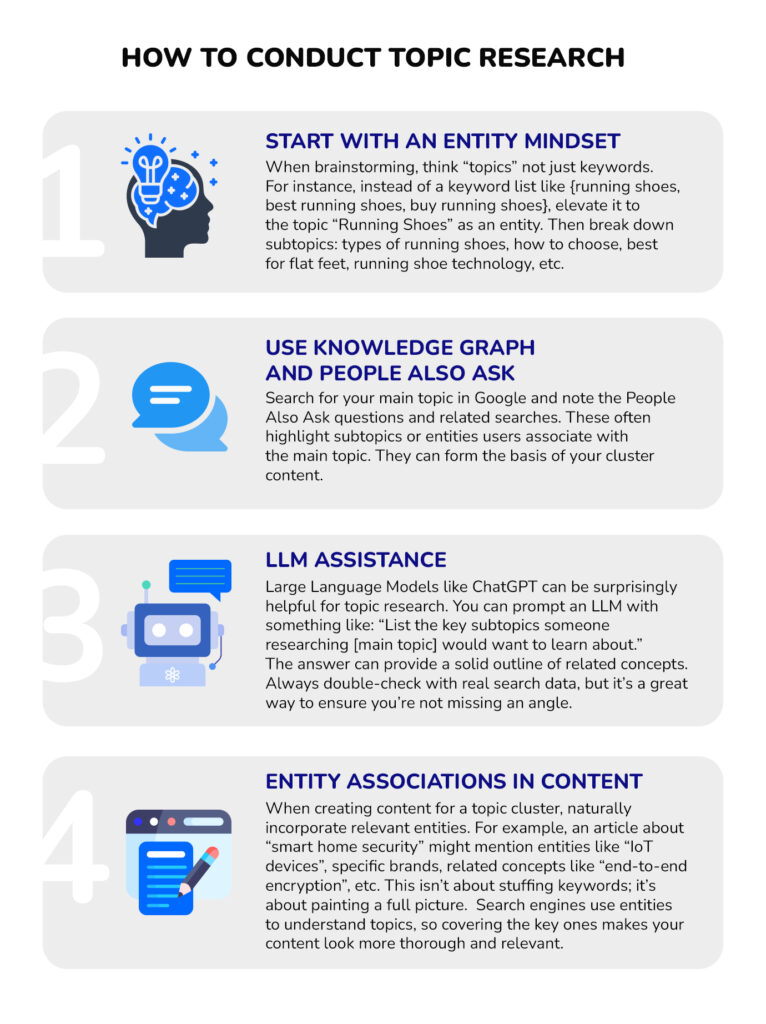
Remember, an entity-based strategy also aligns with voice and AI searches. Users may ask broad questions (“Tell me about improving home security”) and an AI will draw on content that has broad yet detailed coverage. By building out authoritative topic hubs, you increase your chances of being the source an AI agent cites or summarizes.
Leveraging Modern Keyword Research Tools and Techniques
Gone are the days when keyword research meant plugging a term into Google’s Keyword Planner and exporting a CSV. In 2026, we have a suite of advanced tools, many augmented by AI. that can supercharge your research. Here we’ll cover the modern toolkit and how to use each tool effectively:
Google Search Console (GSC) & Search Console Insights
GSC is a treasure trove of first-party data that tells you exactly how users are finding your site. It’s entirely free and provides “real-life search data based on actual searches leading to your website”, something third-party tools approximate with estimates. Use the Performance report to see which queries you already rank for. Pay special attention to:
- “Low-hanging fruit” keywords: queries where you rank on page 2 (positions ~11-30). These have potential to jump to page 1 with optimization. A slight content tweak or better internal linking could yield quick wins.
- High-impression, low-CTR queries: If certain keywords have a lot of impressions but few clicks, it could indicate your title/meta isn’t compelling or that a SERP feature (like an AI answer or featured snippet) is stealing attention. Optimize your snippet or consider adjusting the content to better fit the intent.
- Unexpected queries: GSC often reveals terms you didn’t intentionally target but are ranking for nonetheless. These are content gap opportunities – if people find you for those terms, imagine how much better you’d do with a dedicated piece on it.
- Trends over time: Use the date filters and even the new Search Console Insights interface to spot rising queries and top-performing content. Search Console Insights (which combines data from GSC and Google Analytics) can highlight your recently trending pages and refer you to what drove their traffic. This can spark ideas for related content or expansions.
How to use GSC practically: Start every new keyword research project by reviewing your site’s GSC data. It grounds you in reality showing what Google already associates your site with. For example, if you run an e-commerce site and discover through GSC that you’re getting unexpected hits for “sustainable packaging” queries, that might indicate user interest in that subtopic, perhaps you should create content around your eco-friendly packaging process. GSC can also guide your content refresh priorities: keywords that are slipping in average position or pages with declining CTR may signal content that needs an update to meet new intent.
To stay ahead of the game, you can also segment your GSC queries by length using RegEx filters. Grouping queries into buckets (like 1-word, 2–4 words, 5–8 words, etc.) helps you quickly understand intent patterns. Copy paste these formulas:
1 word queries: ^[^” “]*$
2-4 word queries: ^([^” “]*\s){1,3}[^” “]*$
5-8 word queries: ^([^” “]*\s){4,7}[^” “]*$
9-12 word queries: ^([^” “]*\s){8,11}[^” “]*$
13-20 word queries: ^([^” “]*\s){12,19}[^” “]*$
20+ word queries: ^([^” “]*\s){19,}[^” “]*$
Shorter queries usually reflect broad or navigational searches, while longer queries show more specific intent and many of these longer phrases are often conversational or AI-prompt-style queries. These RegEx filters make it easy to identify those natural-language, question-like searches so you can optimize for them.
ChatGPT (and other LLMs)
ChatGPT (and other AI tools with browsing) have become a big part of keyword research in 2025. What once seemed unusual is now normal. With live web access, these tools can quickly gather information, spot trends, and help you research topics much faster than doing it manually.:
- Brainstorming and Clustering: You can use ChatGPT to come up with related keywords, questions, or synonyms for any topic. For example: “Give me 20 questions an HR manager might ask about employee wellness programs.” This helps you find long-tail keyword ideas that normal tools may miss. You can also give ChatGPT a list of keywords and ask it to group them by topic or intent, basically creating an AI-powered keyword cluster.
- Competitive Research: An LLM can summarize a competitor’s site or content. For instance, ask ChatGPT to list the main topics covered on CompetitorX’s blog, or to extract frequently asked questions from CompetitorY’s FAQ page. This is a quick way to gather insight into competitor content strategies which you can then refine with formal tools.
- Content Gap Discovery: If you have keyword lists from your site and a competitor’s, you can ask ChatGPT to compare them and point out topics they cover that you don’t. It won’t be as exact as SEO software, but it can highlight missing ideas in a very easy-to-understand way.
Important: Always verify AI-generated suggestions with real data. The strength of LLMs is pattern recognition and speed, but they might output some irrelevant or low-volume terms. Use the suggestions as a creative springboard, then check search volumes and difficulty in your other tools.
Third-Party SEO Tools (Semrush, Ahrefs, etc.)
Third-party SEO tools are still extremely helpful for keyword research. They let you expand a topic into many keyword ideas, sort keywords by intent, find questions people ask, and compare your site to competitors to spot missing opportunities.
Many tools now include AI features that group related topics and suggest content ideas. Other data sources, like trend tools or question-finding tools, can show what topics are becoming popular and what users want to know. Content optimization tools also help by showing what top-ranking pages include, so you can improve your own content based on real search patterns.
A best practice is to combine multiple data points. No single tool is perfect. For instance, you might find a keyword in Semrush’s gap analysis, then verify its volume and check real click rates in Ahrefs, then see if you have any impressions for it in GSC (perhaps long-tail variants). If all signs point to “opportunity,” you can proceed confidently..
Identifying Competitor Content Gaps and Topic Clusters
Your competitors can be one of your richest sources of keyword insight. Chances are, they’ve written on topics you haven’t, and vice versa. A content gap analysis systematically uncovers these opportunities. A content gap is essentially anything missing from your content that your audience is searching for but not finding on your site. This typically includes:
- Uncovered topics: Important subjects or subtopics your competitors rank for, but you have little or no content on.
- Missing keywords: Specific search terms that people use where your site doesn’t appear, but competitors do.
- Shallow coverage: Areas where you have some content, but it’s not as deep or comprehensive as what competitors offer (for example, you have a blog post on a subject where a competitor has a full pillar page and multiple detailed subpages).
- Outdated content: Content you have that once targeted a keyword but is now outdated, while competitors have fresher content (thus effectively a gap in freshness).
Identifying these gaps has huge ROI. It’s like having a roadmap of “what your audience is searching for but not finding on your site… if your competitors are getting traffic that should be yours, they’re likely covering topics you haven’t. In other words, closing these gaps lets you steal back traffic that’s currently going to others.
How to perform competitor gap analysis
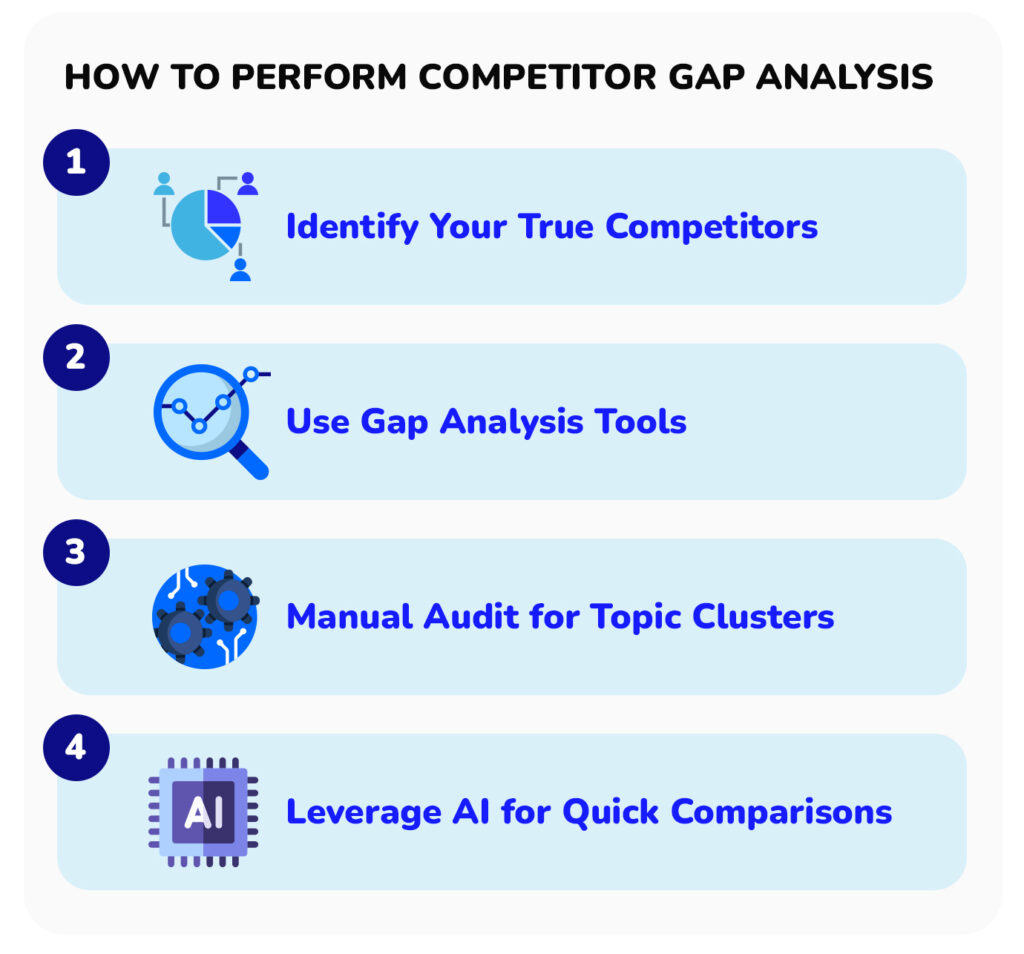
- Identify Your True Competitors: In SEO, your competitors are not just who you think they are in business, but who ranks for the keywords you want. Use Google to search some core terms in your niche and note the domains that keep popping up. Tools like Semrush can list “competitors” based on shared keywords. Focus on a handful (the ones outranking you in many areas).
- Use Gap Analysis Tools: As mentioned, many 3rd party tools are built for this. Input competitor domains and yours, you’ll get a list of keywords where they rank and you don’t. Pay attention to:
- The relevance of the keywords (make sure they align with your audience and offerings).
- The search volume and difficulty to prioritize which gaps are most valuable and feasible to target.
- The competitor’s content that ranks – click through to see what they’ve created for that keyword. Is it a blog post, a product page, a guide? This will inform what you need to create.
- The relevance of the keywords (make sure they align with your audience and offerings).
- Manual Audit for Topic Clusters: Automated tools can give you keywords, but it’s also important to look at your competitors’ content yourself. Check their website or blog and see which topics they cover in depth that you barely mention. For example, they might have a full beginner’s guide series while you only have one or two posts. Or their help center might answer many common questions that you haven’t turned into content yet. Make a list of these bigger topic areas where your site is missing or weak. Make a list of these broader topic clusters that are underdeveloped on your site.
- Leverage AI for Quick Comparisons: You can use ChatGPT by giving it two lists (competitor topics vs yours) and ask for differences, as noted earlier. It might summarize that “Competitor X has a lot of content on [Topic Y] which you lack.” Use that as a pointer and then validate with your own analysis.
Once gaps are identified, integrate them into your topic cluster strategy. For example, you discover a gap: your competitor ranks for “network security best practices” and you don’t, and they also rank for related terms like “firewall configuration tips” and “zero trust networking.”
This hints at a cluster around the entity Network Security. To close the gap, you might create a pillar page “Comprehensive Guide to Network Security for Businesses” and supporting articles on each subtopic (firewalls, zero trust, etc.), linking them together. By doing so, you not only target the specific missing keywords but also bolster your site’s authority on the broader topic.
It’s also useful to find content format gaps. Perhaps all your competitor’s top pages for high-value keywords are tools or calculators (like an ROI calculator, or a price comparison widget) while you only have text articles.
That’s a gap in content type. Filling it might mean developing a similar tool or something unique that serves the search intent in a way users prefer. SERP features are diverse and if a query is best served by an interactive map or a video, and your competitor has it and you don’t, that’s an opportunity to differentiate.
Regularly performing content gap analysis (say quarterly or at least yearly) ensures you stay on top of evolving trends. Gap analysis is how you keep your keyword strategy aligned with the current state of play.
Tactical Keyword Research Workflows and Real-World Scenarios
Having covered the concepts and tools, let’s outline a practical workflow for conducting keyword research in 2026, and then explore how strategies might differ for different scenarios like B2B SaaS vs. e-commerce.
Disclaimer: This is not a 2-hour process, I’m warning you!
A Step-by-Step Keyword Research Workflow
Step 1: Define Goals & Seed Topics – Start by understanding the business goals and target audience.
Are you looking to increase top-of-funnel traffic with informational content, drive product sales, generate B2B leads? Clarity here will influence keyword selection (e.g., a B2B site might prioritize thought leadership keywords, whereas an e-commerce site might focus on product and category terms). From the goals, list out seed topics (typically broad terms related to your products/services or audience needs). For example, a company selling project management software might have seeds like “project management,” “team collaboration,” “Agile planning,” etc.
Step 2: Gather a Broad Initial Keyword List – Use multiple sources to expand your seeds.
- Plug seeds into tools to get hundreds of related terms and questions. Export these lists.
- Use Google Autocomplete and People Also Ask: type your seed into Google and note the suggestions and PAA questions, add those to the list.
- Include any internal data: site search queries (what people search on your site, if you have a search bar), frequently asked questions from sales/support teams, feedback from customers. These often contain gold nuggets of keyword ideas in the customers’ own words.
- If relevant, look at forum sites or communities (Reddit, Quora, industry-specific forums) for common questions or discussions around your topic – those can be turned into target keywords or at least content ideas.
Step 3: Refine and Cluster by Intent and Topic – Now you likely have a huge list (possibly thousands of keywords). It’s time to organize.
- Clean the list by removing duplicates and anything obviously irrelevant.
- Tag each keyword with an intent. You can also do quick manual checks: keywords containing words like “buy”, “price”, “discount” are likely transactional; ones phrased as questions or starting with “how/what” are informational; single-word or category terms could be navigational or broad informational depending on context.
- Group the keywords into logical topics. For example, your seed “project management” list might naturally split into clusters like {general project management, Agile methodologies, project management software features, project planning techniques, etc.}. You can do this clustering with the help of tools (some tools have a “cluster” feature using AI, or you could use Python or even ChatGPT as discussed) or manually via a spreadsheet pivot table or just sorting by similarity. The goal is to identify when multiple keywords are essentially variations of the same user need.
- As you cluster, identify a representative primary keyword for each cluster (usually the highest volume one or the one that best captures the intent). That will be the main target for that content piece, with others as secondary targets to sprinkle in.
Step 4: Analyze the SERPs & Competitors – For each cluster’s primary keyword, examine the current top results on Google.
- What type of content is ranking? (Blog articles, product pages, videos, forums?) This tells you what Google believes satisfies that query. Your content plan should match or improve upon that format.
- Are there SERP features? (e.g., featured snippet, image carousel, local pack, videos, AI overview, etc.) If, say, a featured snippet exists for a “how to” query, aim to create a step-by-step section in your content that could capture that snippet. If an AI summary appears, ensure your content is factually rich and well-structured – it might increase your chances of being cited.
- Who are the competitors on page 1? Open their pages and quickly assess: How comprehensive is their content? What subtopics do they cover? This is effectively reverse-engineering the ranking content to ensure your piece will be better. Jot down any subtopics or angles they use that you might have missed.
- Check if you or others already have content on that cluster. If you have something outdated, you might update it rather than create something new. If a competitor’s content is weak, that’s good news, an opportunity to outrank with superior content.
Step 5: Prioritize with Data – You likely have more clusters/keywords than you can tackle at once. Prioritize by combining metrics and business value.
- Look at search volume (how many searches per month) but adjust for difficulty (how hard to rank, often indicated by a score or by looking at competitor domain strengths). A keyword with 1000 searches and low competition might be more valuable than one with 3000 searches dominated by megasites.
- Consider conversion potential: A lower-volume query like “enterprise project management software ROI” might be extremely valuable to a B2B SaaS if it indicates a searcher ready to invest in a solution, whereas a high-volume query like “project management definition” might be mostly students or broad info seekers. So, prioritize according to relevance and potential ROI, not just traffic.
- Factor in content gap urgency: If your analysis showed you have zero presence for a critical topic that competitors are winning at, that might deserve fast-tracking.
- Also, consider quick wins vs. long plays: Some keywords you can rank for quickly (perhaps you’re already on page 2 and just need to optimize). Others might be part of a long-term authority build. A balanced strategy does both – quick wins sustain momentum while long plays build future growth.
Step 6: Develop the Content Plan – For each priority keyword/cluster, decide: are we creating new content or updating existing? Then outline the content needs.
- Write briefs for new content that detail the keyword, intent, and subtopics to cover (ensuring all those related questions/entities are included).
- Plan for multimedia if needed (images, infographics, videos) especially given multisearch – having original images or videos with proper alt text and transcriptions can give you an edge in image or video search results.
- Include internal linking plans: as you create these cluster pages, link them to each other and to the relevant pillar pages. This boosts your topical authority signal and helps users navigate the whole topic.
- Don’t forget on-page SEO basics: clear, descriptive titles (maybe even including a year e.g. “… in 2026” if relevant), engaging meta descriptions, FAQ schema for Q&A content, and schema markup where appropriate (product schema, HowTo schema, etc., which can help you appear in enriched results).
Step 7: Monitor and Iterate – Once implemented, monitor performance. Use GSC to see if new queries start appearing for that content. Watch ranking progress (SEO tools or GSC position tracking). If something isn’t moving, revisit, perhaps the competition requires more depth or you need backlinks to boost authority. Αgorithms are quick to test new content; you might see initial volatility. Adjust as needed, and use that feedback to refine your approach for the next set of keywords.
This workflow blends strategic research with tactical execution. Next, let’s see how some tactics might shift in different real-world contexts.
B2B SaaS vs. E-commerce: Keyword Strategy in Practice
SEO is not one-size-fits-all. Two common scenarios are B2B SaaS (business-to-business software-as-a-service) companies and E-commerce businesses. Both rely heavily on organic search but in different ways. Below is a comparison of how keyword research and content strategy might differ between them:
| Aspect | B2B SaaS SEO Strategy | E-commerce SEO Strategy |
| Audience & Search Behavior | Smaller, professional audience.Searches focus on solving problems, learning, and comparing solutions.Lower search volume but deeper intent.Longer sales cycle with many touchpoints. | Broad consumer audience.Searches include product names, categories, attributes, and long-tail phrases.High search volume, often fast purchase intent.Local and marketplace searches can play a big role. |
| Keyword Types & Intent | More informational and commercial-intent keywords.Examples: “how to…” guides, industry problems, software comparisons.Many top/mid-funnel keywords for education (guides, case studies).Transactional queries exist but usually lead to lead generation, not instant purchase. | Very transactional keywords (“buy…”, “price…”, product details).Also uses informational keywords that lead to purchases (“best X”, reviews).“Near me” searches matter if stores exist.Strong navigational behavior on marketplaces. |
| Content Format & SEO Tactics | Heavy focus on content marketing: blogs, guides, tutorials, case studies.Topic clusters and pillar pages are essential.Thought-leadership content to build authority.Technical SEO is simpler but EEAT is crucial. | Core focus on category and product page optimization.Strong use of images, alt text, and product attributes.Content like buying guides, comparisons, and “Top 10” lists.Internal linking and schema markup (Product, Review, FAQ) important.Long-tail product keywords offer big opportunities. |
| Tools & Data Sources Emphasis | Uses industry forums, professional platforms, and customer pain points for ideas.Google Search Console helps spot trending tech topics.Connects keyword performance to CRM/lead quality. | Uses product feed data, shopping insights, and marketplace suggestions.Tracks internal site search for new keyword ideas.Seasonal trends and pricing competition are big factors. |
| Future Trends & Multi-Modal | AI assistants will influence research (“top tools for…” queries).Structured, authoritative content helps brands appear in AI answers.Voice search may matter for quick, mobile, or troubleshooting queries.Multi-modal search could involve screenshots of errors or interfaces. | Visual search (Google Lens, Pinterest, Instagram) is growing fast.High-quality product photos and rich image metadata are essential.AR/visual content is becoming more common.Voice shopping (“order more…”) integrates with SEO.Optimized product feeds help assistants recommend the right products. |
B2B SaaS SEO focuses on depth of information and nurturing prospects through expertise-driven content with keywords that often reflect problems and questions, whereas E-commerce SEO focuses on capturing purchase intent and optimizing the catalog for how consumers search (often visual and adjective-rich queries). Both require a mix of creativity and data-driven decision making, just applied in different proportions.
Future-Proofing Your Keyword Strategy with AI and SERP Prediction
Here are strategies to future-proof your keyword research and content planning in the age of AI and ever-evolving SERPs:
Embrace AI as an Assistant and a Target
Use AI both as a helper and as something you need to optimize for. Tools like ChatGPT can support your keyword research and content planning, but AI also shows information to users through features like Google’s AI Overviews This is where Answer Engine Optimization (AEO), is about making your content the preferred source for AI summaries.
Practical steps include: writing clear and factual content (AI prefers content it can easily parse and trust), using schema and structured data (to help machines understand your page context), and establishing brand authority. One experiment showed that when a new blog post was published, ChatGPT updated its answer about that topic within hours by using retrieval to scan the web. This means fresh content gets noticed quickly by AI – keep your content updated and timely.
Monitor SERP Behavior and Adapt
Pay close attention to how Google’s SERPs change for your key queries. If you notice more AI-generated answers or new SERP features (e.g., an “Explore” section, interactive maps, etc.), adjust your strategy. For example, if an important keyword for you suddenly starts showing an AI Overview, recognize that fewer users may click through. You might respond by:
- Refining content to be the kind that gets cited in the AI answer (e.g., include concise definitions or step-by-steps that the AI might quote).
- Targeting longer-tail queries that stem from the initial query. Often, after getting an AI summary, users ask more specific follow-ups. If you can predict and cover those, you capture the second wave of searches.
- Measuring new metrics: Instead of just ranking and click-through, look at visibility metrics, and engagement of those who do click (since those might be highly motivated visitors). Adjust your KPIs – for instance, if raw traffic drops but conversion rate increases due to higher intent clicks, that might be acceptable.
Diversify Content Types and Platforms
The notion of “keywords” is expanding beyond the traditional web SERP. People might search within YouTube (so consider video content and YouTube SEO for important keywords), within podcast directories (maybe optimize titles/show notes for search), or within app stores or other ecosystems.
While organic web search is the focus, being aware of these other channels can help your strategy. For example, seeing lots of “how to” queries in your research? Perhaps a video tutorial series (with proper titles and descriptions) could capture an audience on YouTube and even appear in Google video carousels. The more touchpoints you cover, the more resilient your organic visibility if one channel changes algorithmically.
User Experience and Engagement as Ranking Signals
As search engines become more advanced, they are looking beyond keywords to user satisfaction. Ensure that when users do click your result, they have a good experience – fast load times, useful content, clear next steps. Google’s core updates and helpful content updates in recent years all stress that useful, people-first content wins in the long run. High engagement and low bounce rates send positive signals that indirectly help your rankings for the right keywords.
Continuous Learning and Team Upskilling
Lastly, keep your team informed. SEO in 2026 moves quickly with AI evolutions. Regularly follow reliable sources (industry blogs, Google Search Central announcements, SEO communities) to catch wind of new features or best practices.
If Google rolls out, say, Gemini AI search fully (a hypothetical next-gen AI in search), be ready to experiment and adjust. Treat your keyword strategy as a living thing – regularly audit and update your keyword lists, prune irrelevant ones, and add new queries that emerge.
By mixing these future-focused ideas with the core tactics we covered, you can build a keyword and content strategy that works now and stays flexible for the future. In 2026, the brands that win at SEO are the ones that truly understand user intent, use modern tools, and adapt quickly. Keep this mindset, and your organic performance will stay strong no matter how search continues to change.
Conclusion
Keyword research in 2026 is much more advanced than it used to be. It combines understanding what people really want, using AI tools, studying competitors, and planning for where search is going next. Focusing on topics and entities helps you create content that works for both users and search engines.
Using data from tools like GSC, keyword platforms, and even AI assistants helps you make smart, timely decisions.
Finding content gaps and organizing your topics makes you more competitive, while adapting to AI and multi-modal search keeps your strategy future-proof.
For experienced SEOs, the goal is to use new methods without forgetting the basics: know your audience, offer real value, and track what matters. All the modern strategies are just extensions of that. If you stay proactive and focused on the user, you’ll continue to grow organically in 2026 and beyond.