
In this guide, we reveal how many keywords you need to use on a page for optimal SEO. From the distribution of keywords to the choice of quality over quantity, our article offers practical advice and strategies to improve the visibility of your site and attract targeted traffic. Get answers to the most important SEO questions and start applying effective methods today.
What is a keyword list?
Your keyword list is simply a set of search queries (keyword or keyphrases) that are directly or indirectly related to the field of your website. There is no specific format for creating such lists. You can do it on paper, but better go with Google Sheets – easy to edit, store and transfer.
The list of keywords is recommended to be stored and updated regularly. There are several reasons for this:
- a list of keywords is a clear starting point by which you will be able to measure further success (or failure);
- such a list will give you a better understanding about your long-term goals;
- The list is also a valuable resource for other (or new) members of your team.
Google regularly releases updates to its search engine. One of such updates made the search much more sophisticated. Google learned to decipher both the information on your website, and user queries and match them. The engine can show your website in response to user queries, even if those contain no keywords from your website at all.
How long should your keywords list be?
The list should include all the relevant keywords you use, from niche terms and definitions, titles, categories, to different stages of the buying process you incorporate, specific queries from different customers, and so on.
Depending on your business goals, competition, and long-term planning, aim for 50-100 keywords, and then just add to this list regularly every 2-4 months.
So, with a volume of 50-100 keywords for the period of 2-4 months, it is best to give top priority in promoting the top 25% of the entire keyword list, no more. Those, ideally, will also have an effect on the growth of promotion for the remaining 75% of the keywords from the list.
Make sure you select keywords that are relevant to your business and have a high search volume. And don’t forget about competition, watch out for keyword difficulty. If a lot of companies are already ranking for the chosen keyword, it will be more difficult for you to break into the first place. Prioritize wisely.
Understanding Your Target Audience: The Foundation of SEO
Understanding the audience is at the heart of successful SEO. Analyzing the needs and behavior of your audience determines the choice of keywords, creating valuable and relevant content that meets their queries and increases the value of your site.

For example, if you are promoting a local bakery, research may show that potential customers are searching not just for “bakery” but for “vegan bakery in [your city].” Such findings guide you to more precise and effective keywords, such as “vegan desserts,” ensuring the attraction of your target audience.
For a deep understanding of the audience, use analytical tools and methods such as surveys, customer feedback, and social media analysis. These data not only help choose the right keywords but also reveal which content will be most in demand among your audience.
Quality Vs Quantity
We explore why, in the world of SEO, the quality and relevance of keywords surpass their quantity. Precisely selected keywords can improve your site’s positions in search results.
Practical example: Imagine you are working on SEO for a healthy eating blog. Choosing the keyword “healthy breakfasts” and creating deep, informative content that thoroughly describes various recipes, the benefits of each dish, and preparation tips will be much more effective than using dozens of less specific queries like “breakfast,” “healthy food” without providing specific value.
Improving the Quality of Keywords
Research visitor intentions understand exactly what your potential customers are looking for and what tasks they aim to solve.
Focus on long-tail keywords such queries are often less competitive and more specific, allowing you to attract more targeted traffic.

Competitor analysis study what keywords your competitors use and how they integrate them into their content to find potential weaknesses and advantages for your strategy.
Ultimately, striving for keyword quality should go hand in hand with creating valuable and relevant content. This approach not only improves the visibility of your site in search results but also provides a positive experience for users, which is the ultimate goal of any SEO strategy.
Optimal Keyword Distribution
Proper distribution of keywords across the page contributes to SEO improvement. It’s important to use keywords in headings, meta-tags, and alternative text for images.
Practical example: Suppose you are creating a page about the best methods of caring for indoor plants. Using the phrase “care for indoor plants” in the title, subtitles, introduction, and alt-texts of images demonstrating different care types will improve the SEO indicators of the page. However, it’s important to maintain a balance so that the text remains attractive and understandable to readers, avoiding oversaturation with the same expression.
Boost your SEO results! Link building has become fast and easy with Serpzilla. Buy quality backlinks on authority websites with high DR.
Tools for Working with Keywords
An overview of the most important tools for selecting and analyzing keywords, such as Google Keyword Planner, SEMrush, Ahrefs, Ubersuggest, and Moz Keyword Explorer, which will help you find the most suitable keywords for your site.
- Google Keyword Planner: A free tool from Google that is ideal for initial keyword research. It provides data on search volume and competition, helping to identify effective keywords for your campaign.
- SEMrush: A powerful paid tool that offers extensive data on keywords, including their difficulty, search volume, and ranking potential. SEMrush also allows you to analyze your competitors’ keyword strategies, which can provide valuable insights for your own strategy.
- Ahrefs: Another paid tool that is an excellent choice for keyword research and competitive analysis. Ahrefs offers detailed information on why certain pages rank for given keywords and how you can use this data to improve your content.
- Ubersuggest: A free tool from Neil Patel that offers detailed analytics on keywords, including ideas for long-tail keywords and competition data. This tool is suitable for generating new ideas and expanding your list of keywords.
- Moz Keyword Explorer: A paid tool that provides comprehensive information about keywords, including search volume, difficulty, and organic CTR. Moz also offers unique metrics, such as keyword priority, which help determine which keywords to focus on first.

How to create the right list of keywords?
Mainly there are three categories of keywords:
- Keywords of inquiry,
- Keywords of intent,
- Key phrases (queries of 3+ words).
First, create a list of first-order keywords
These are keywords of broad meaning and high coverage. For example, “construction”, “software”, “food”, “sports”, etc. Basically, a list of broad, but relevant topics. These keywords do not have much meaning for us on their own, but they are needed in order to find and select the keywords that can be used to promote our website.
These keywords can be pulled from tools like Ahrefs via their Keywords Explorer.
Here is an example:

1. Go to Keywords Explorer and enter your first-order keywords
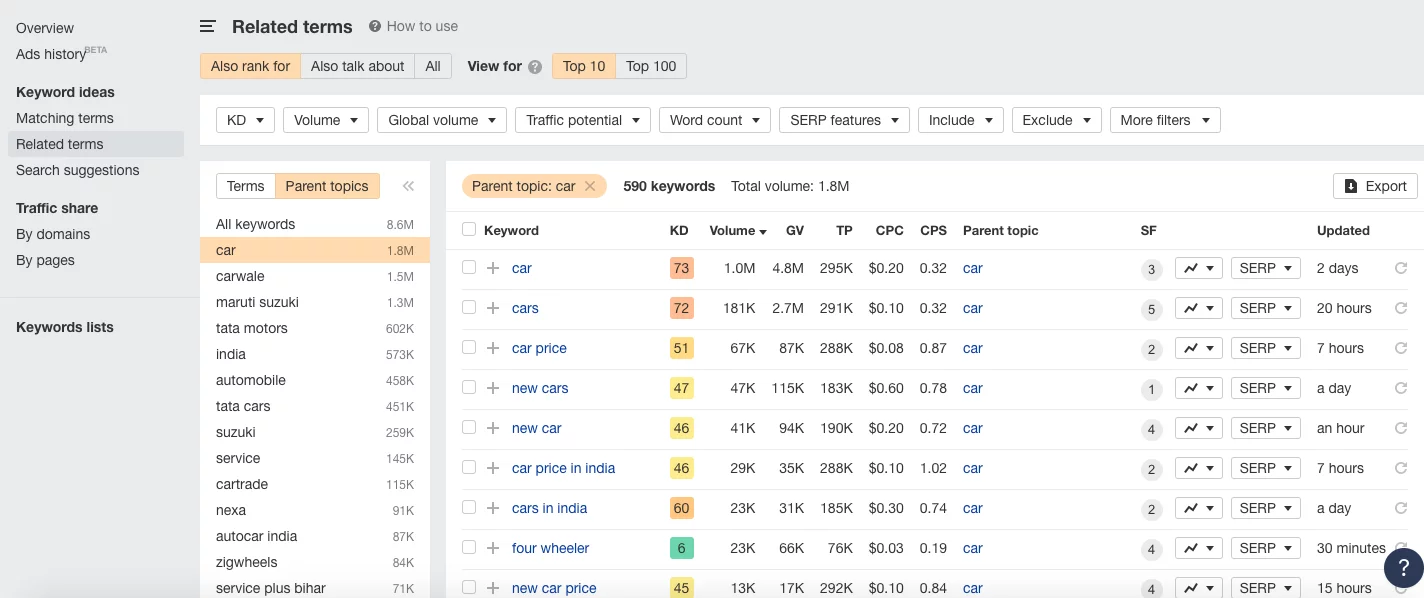
2. Choose “Related terms” in a sidebar and then pick “Parent topics” filter to see all the related suggestions with the metrics necessary for evaluation.
Next, filter your keywords by relevance
Now you have thousands of keywords to choose from, but what to do with such a large amount of data? The next step is to filter those keywords by relevance. Only the most relevant keywords will really drive traffic.
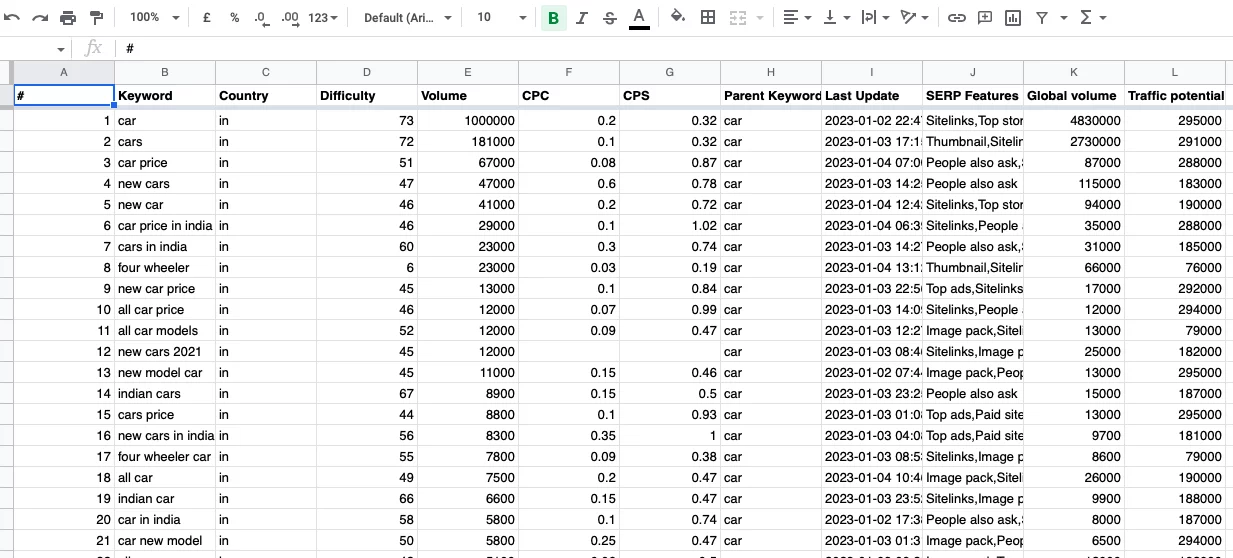
First, export the data to Google Sheets
What to filter to get the most:
- Eliminate irrelevant keywords. Remove all irrelevant keywords from your lists, not unless you intend to use them later. In that case, mark them to avoid confusion.
- Eliminate branded keywords. Branded keywords should be omitted, unless it is your brand.
- If your business is in a small city, give priority to common keywords. In a small city, services are likely few and you might get good traffic even with “parent keywords”.
- If your business is located in a big city, focus on keyphrases. High competition and a high variety of services and goods make it impossible to make it without keyphrases. So that’s what you should focus on. Sometimes seemingly similar keyphrases (high quality car service and nearest quality car service) can vary in traffic significantly.
- If you have a nationwide business, go for keyphrases, but also do some research. Here you won’t make it with keyphrases alone. In different regions, the same type of business can be promoted using different keyphrases and with different effectiveness, so you have to conduct a competitor keyword research. That way you can ensure the effective promotion of your business in all regions.
Look at the metrics of your keywords
Once you’ve filtered your list, the next thing you need to do is look at the metrics.
There are many metrics available for keyword research in Ahrefs that will be useful:
- Search Volume: this is a metric reflecting how often a keyword is searched. Low search volume queries are the ones no one is searching for, so these are to be avoided.
- Trends: this is a metric reflecting changes in search volume over time. For example, if the search volume for a query has been steadily declining over the past months, it is probably worth not using it. Conversely, if a query shows an upward trend, it makes sense to include it in your list.
- Difficulty: this is a metric reflecting how difficult it will be to rank for a keyword.
- CPS (clicks per search): this metric reflects how often a search for a query ends with a click and redirection to your page. Low CPS can mean that people are finding the right information on the SERP and decide to not visit the website.
Study Your Competitors
Competitor research can save you a significant amount of money and a lot of time.
Ahrefs and other tools allow you to analyze competitor keywords. This is necessary to understand exactly what queries their website is directly targeting. If your competitor is well established in a niche, the keywords they target may be the result of years of analysis, along with trial and error. Take advantage of this experience.
After studying the queries of competitors, you can make one big list of queries in your niche. By the way, don’t forget about the domains you research. In the future, they will be useful for creating your backlink profile.
Put it all together and match it to your website’s URLs
Now you have a list of keywords you need, and you need to make a table in which you distribute the keywords between different pages of your website. What for? To contribute to the competent design of your website structure, Google loves well-structured websites. It is very similar to backlinks, which should lead from the relevant referring domain to the relevant page. So we want SERP to show our potential customers the page of our website that is most relevant to their query.
Use the list of keywords to determine the topics that will be covered. Then group sets of pages around those topics, and only then match specific keywords to specific pages. Make the list clear and accurate, it can still come in handy in the future – when the company develops, changes employees, or contacts a third-party SEO agency.
Pay attention to keyphrases
One way to increase your chances of ranking for a keyword is to focus on keyphrases. Such queries are way more specific and usually have a smaller search volume than regular queries consisting of one or two words.
For example, “car service with a body shop in Nagpur” is a specific request (keyphrase), and “car service” is not. Keyphrases tend to have less competition because they are more specific. And their specificity usually indicates that the person entering this keyphrase is presumably in the purchase cycle somewhere in the funnel. So it’s only logical that if you rank for such keyphrases, you will be more likely to get leads and increase your sales.
Keyphrases should have a higher priority on your list if your primary goal is sales. Regular keywords should be a higher priority if your goals are recognition, visibility, and establishing expert status on the market.
How can keywords interfere with promotion?
When you have multiple pages on your website that target the same keyword, both pages can end up lower on search engine results pages (SERPs). This is because such duplication confuses search engines, making it difficult to determine which page is most relevant to that keyword.
To avoid this situation, make sure you use unique keywords for every page on your website. And if you do have multiple pages targeting the same keyword, at least make sure each page offers something unique. For example, one page is for purchasing a product and another is a blog post about that product.
When determining the length of your list of keywords, keep in mind that there should be enough of them to create unique content that won’t compete with other pages on your website.
Conclusion: Strategies for Successful SEO
In conclusion, the optimal number of keywords on a page for SEO is not determined by a rigid number but depends on the quality and relevance of the content. The main focus should be on creating value for the reader, naturally integrating keywords into the content, headings, and meta-tags. Remember the balance between quality and quantity, as well as the constant adaptation to changing search engine algorithms.